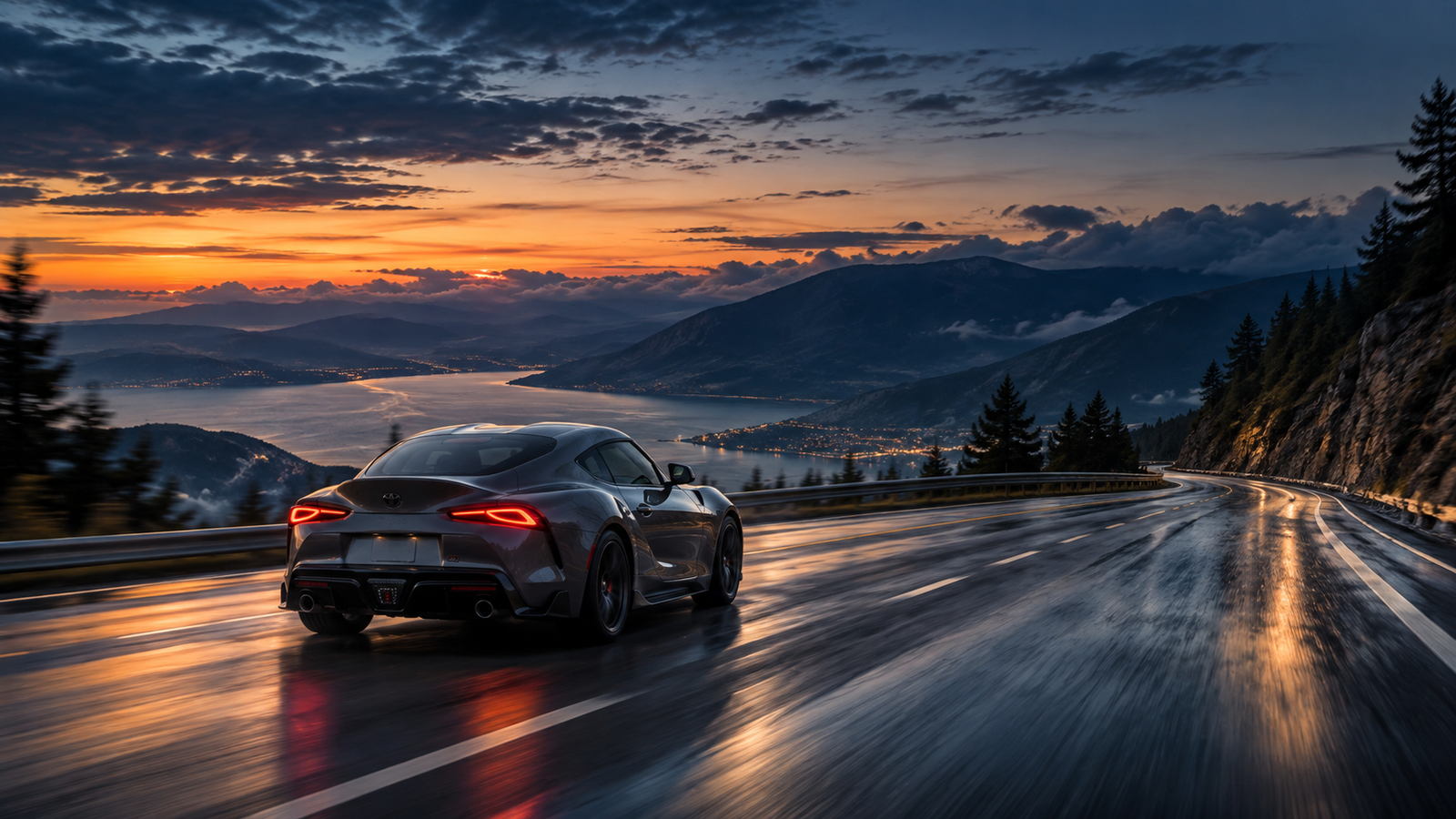
A car can be fast.
It can have a powerful engine, aggressive styling and enough horsepower to make every highway entrance feel dramatic.
But none of that guarantees that it will be a great road trip car.
After several hours behind the wheel, different qualities begin to matter.
The seat that felt comfortable during a 20-minute test drive suddenly matters a lot more. Road noise that seemed insignificant becomes impossible to ignore. A suspension that felt sporty around town may start to feel tiring. Even the way the car holds its line on a highway can change how relaxed you feel.
A great road trip car is not necessarily the fastest car. The atmosphere can become even more important when the road stretches into the night.
It is the car that makes the miles feel easier.
So what actually makes a car good for long-distance driving?
Here are seven things that matter more than horsepower.
1. Comfortable Seats Matter More Than You Think
The first few minutes in a car can be deceptive.
Almost any seat can feel comfortable when you first sit down.
The real test begins after two or three hours.
Long-distance driving puts your body in almost the same position for extended periods, which means small problems become much more noticeable over time. Poor lumbar support, an awkward seat angle or insufficient thigh support can turn into discomfort long before the destination arrives.
A good road trip seat does not necessarily need to be extremely soft.
In fact, a seat that feels wonderfully soft in a showroom may not provide the support you need after several hours.
What matters is how naturally your body is supported.
You want enough adjustment to find a relaxed driving position, good lower-back support and enough thigh support without feeling trapped by aggressive bolsters.
The relationship between the seat, steering wheel and pedals matters too.
If you constantly need to reach for the steering wheel or stretch your legs to use the pedals, the problem may not be the seat itself. It may be the entire driving position.
For a road trip, comfort is not a luxury.
It is part of the driving experience.
2. A Quiet Cabin Changes Everything
There is a particular kind of fatigue that comes from spending hours surrounded by constant noise.
Engine noise.
Tire noise.
Wind noise.
Road vibration.
You may stop noticing each individual sound after a while, but the cabin is still filled with them.
This is why a quiet car can feel dramatically better on a long highway journey than it does during a short drive around town.
At highway speeds, tire and wind noise can become particularly noticeable. A vehicle with good acoustic isolation creates a calmer environment for conversation, music and navigation.
And this is where the relationship between cars and music becomes interesting.
If you enjoy driving with music playing, a quiet cabin gives the soundtrack more space.
Progressive electronic music can breathe.
Bass feels cleaner.
Small details in the production become easier to hear.
Instead of fighting the sound of the road, the cabin becomes part of the listening environment.
That is one reason the best road-trip cars often feel less dramatic than performance cars.
They do not demand your attention.
They simply let you settle into the journey.
3. Highway Stability Builds Confidence
A good road trip car should feel predictable.
Not necessarily exciting.
Not necessarily aggressive.
Predictable.
At highway speed, you want a car that tracks naturally without requiring constant steering corrections. You want the suspension to control body movement without making every bump feel like an event.
This becomes particularly important when the road stretches for hundreds of miles.
A car that constantly requires small corrections can become tiring.
A car that feels planted and composed can almost disappear beneath you.
That is the ideal.
The steering should communicate enough to give you confidence, while the suspension should keep the body controlled over changing surfaces.
This does not mean every road-trip car needs a soft suspension.
A well-tuned suspension can be comfortable without feeling disconnected.
The goal is balance.
The car should absorb imperfections while remaining stable when the road changes direction, the wind picks up or traffic moves around you.
After several hours, that composure can matter far more than another 100 horsepower.
4. Range Matters When the Road Keeps Going
There is another form of comfort that has nothing to do with seats.
It is the freedom to keep going.
A car with useful range gives you fewer reasons to interrupt the journey.
For gasoline and hybrid vehicles, that means considering real-world fuel economy together with tank capacity.
For electric vehicles, it means thinking about usable range, charging infrastructure and how charging stops fit into the route.
The important word here is useful.
A theoretical range number does not tell the whole story.
Speed, weather, passengers, luggage, terrain and driving style can all influence energy consumption.
The same applies to fuel economy.
A road trip is not a laboratory.
You may encounter mountains, traffic, strong winds, heavy rain or long periods of high-speed driving.
That is why the best road-trip planning is not simply about finding the biggest range figure.
It is about having enough margin to make the journey feel relaxed.
Nobody wants to spend the final 20 miles staring at the range display and wondering where the next fuel station or charger will be.
A great road trip car gives you confidence that the next stop is a choice — not an emergency.
5. Good Visibility Reduces Effort
Visibility is easy to overlook because it is not something you normally put on a specification sheet.
But spend six hours driving and you begin to appreciate how much easier a car feels when you can clearly understand what is happening around it.
A good driving position provides a clear view forward.
The mirrors should give you useful information without excessive blind spots.
The dashboard should not force you to look too far away from the road for basic information.
Even the shape of the pillars and windows can influence how natural the car feels to drive.
Good visibility reduces the amount of mental work required to position the car.
You see the road.
You understand the traffic.
You anticipate what is happening ahead.
The car becomes easier to place.
This is especially valuable when a road trip takes you somewhere unfamiliar.
You may be dealing with unfamiliar exits, different road markings, changing weather and roads you have never driven before.
The easier the car is to understand, the more attention you can give to the journey itself.
6. Useful Technology Should Stay in the Background
Modern cars can do almost everything.
Navigation.
Phone connectivity.
Adaptive cruise control.
Lane assistance.
Multiple cameras.
Voice controls.
Large displays.
The problem is that more technology does not automatically mean a better road-trip experience.
The best technology is often the technology you barely notice.
Navigation should be easy to understand.
Climate controls should be simple to adjust.
Audio controls should not require several menu screens.
Driver-assistance systems can reduce workload on long highway stretches, but they should support the driver rather than become another source of distraction.
The same principle applies to smartphone integration.
If you can start a playlist, change a song or check navigation without fighting the interface, the technology is doing its job.
If you spend more time looking at the screen than looking through the windshield, something has gone wrong.
A road trip should be about the road.
Technology should simply make the experience easier.
7. The Best Road Trip Car Is One You Enjoy Driving
This might be the most important point.
A technically perfect road-trip car can still feel completely wrong if you do not enjoy being behind the wheel.
Because driving is not purely transportation.
There is a reason certain cars stay in our memories long after we have forgotten their specifications.
Maybe it was the steering.
Maybe it was the sound of the engine.
Maybe it was the way the suspension moved over a mountain road.
Maybe it was simply the feeling of leaving the city early in the morning with an empty road ahead.
That emotional connection matters.
A road trip gives you more time with a car than almost any other type of journey.
You hear it.
You feel it.
You learn how it responds.
You become familiar with its controls and its personality.
That is where the idea of a great road trip car becomes different from simply finding a comfortable vehicle. It is also part of what makes a car feel special.
Comfort gets you through the journey.
Character makes you remember it.
So, What Is the Best Car for a Long Drive?
There is no single answer.
The best car for a long drive depends on the journey.
A couple traveling across a continent may want a quiet, efficient sedan.
A family carrying luggage and equipment may prefer an SUV or wagon.
Someone crossing long distances alone may prioritize efficiency and seat comfort.
An enthusiast may willingly sacrifice some practicality for better steering, better handling and a stronger connection with the road.
An EV driver may prioritize charging speed and route planning.
The important thing is not choosing the car with the biggest numbers.
It is understanding what makes hundreds of miles feel effortless.
Supportive seats.
A quiet cabin.
Stable highway manners.
Useful range.
Good visibility.
Simple technology.
And enough character to make you want to keep driving.
Because ultimately, a road trip is not measured only by how quickly you reach the destination.
It is measured by how the journey feels along the way.
And sometimes, the best part is simply finding an open road, settling into the seat, putting on the right music and continuing forward.
As we explored in The Art of the Long Drive, the road itself can become part of the experience.
That is what makes a great road trip car.
Not the number on the specification sheet.
Not the badge on the hood.
But the way the car makes you feel after the road has been running beneath you for hours.
Cars. Roads. Music.
The Experience of Driving.