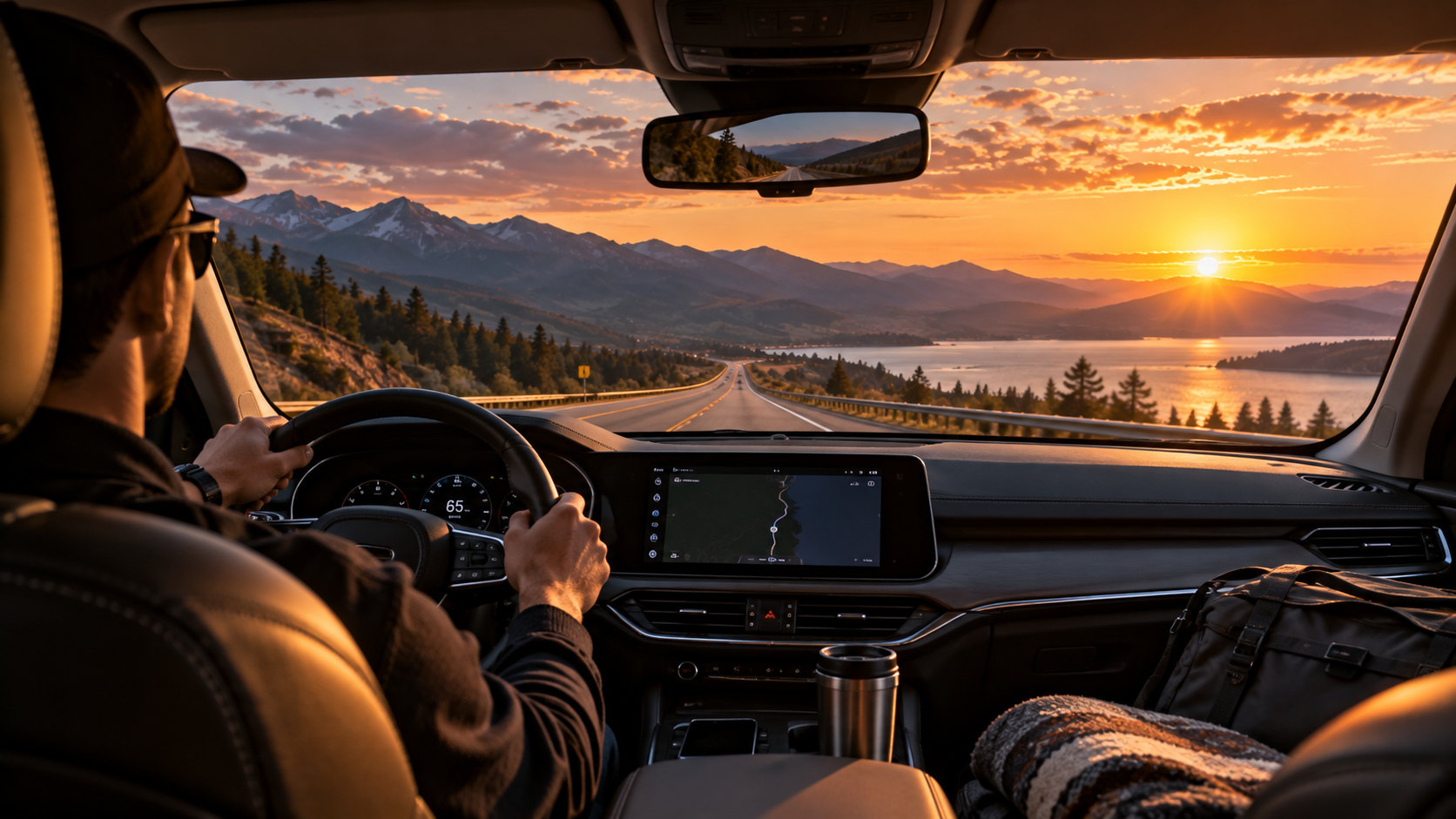
There is a reason people sometimes get in the car without having anywhere particularly important to go.
The destination might be uncertain. The route might be familiar. Sometimes there is not even a real destination at all.
Yet after an hour on the road, something changes.
The noise of everyday life becomes quieter. The scenery begins to move at a steady rhythm. The engine settles into its familiar sound, music fills the cabin, and the road ahead becomes the only thing that really needs attention.
Long drives are often described as a way to escape. But perhaps they are better understood as a way to reconnect with yourself.
Why Does Driving Feel Different When You Have Time?
Short trips are usually about getting somewhere.
You leave home, fight traffic, find a parking space and arrive. The car is simply the tool connecting two points.
A long drive changes that relationship.
When there is no immediate pressure to arrive, driving itself becomes part of the experience. The road becomes something to experience rather than something to cross as quickly as possible.
This is one of the reasons the art of the long drive is so different from ordinary transportation.
The journey has room to breathe.
1. The Road Creates a Natural Rhythm
Long-distance driving has a rhythm that is surprisingly easy to fall into.
The road markings repeat. Trees and buildings pass at regular intervals. The engine maintains a steady tone. The steering requires small, almost automatic corrections.
None of these things are particularly dramatic.
That is exactly what makes them interesting.
The repetition can create a sense of continuity that is difficult to find in everyday life. Instead of jumping between notifications, conversations and unfinished tasks, attention becomes centered on a relatively simple activity.
Drive. Observe. Listen. Continue.
2. Driving Gives Your Brain One Clear Task
Modern life often requires attention to be divided between many things at once.
Driving on an open road can be different.
The driver still needs to remain alert and respond to traffic, road conditions and changing surroundings. But when conditions are calm, the task can feel structured and predictable.
You know where to look. You know what the controls do. You understand the movement of the car.
That structure can make driving feel mentally absorbing without requiring the same kind of constant switching that many digital activities demand.
The important distinction is that driving should never become something that encourages distraction. Phones, messages and other activities that take attention away from the road have no place behind the wheel.
The experience comes from being present.
3. The Scenery Gives You Something New to Look At
A long drive also changes your visual environment.
The familiar streets around home eventually disappear. Buildings become fields. Fields become forests. Mountains appear on the horizon. Cities become distant lights.
Even when the road itself is not particularly exciting, the changing environment can make the journey feel like a sequence of small discoveries.
This is part of what makes some roads more enjoyable than others.
As we explored in Why Some Roads Are More Enjoyable Than Others, curves, scenery, elevation, surface and atmosphere can completely change the character of a drive.
4. Music Becomes Part of the Journey
Music has always been closely connected with driving.
A song heard at home is simply a song.
The same song heard while driving through an unfamiliar city at midnight can become something else entirely.
The road supplies movement. The scenery supplies visuals. The car provides the physical environment. Music fills the space between them.
This is why certain songs become permanently associated with particular cars, roads or periods of life.
Progressive electronic music can be particularly effective during long drives because its gradual development can complement the continuous movement of the road.
We explored that relationship in Progressive Trance and the Driving Experience.
The music does not simply accompany the drive.
Sometimes it becomes part of the memory of the drive.
5. Solitude Can Be Valuable
Being alone in a car is not necessarily loneliness.
For many drivers, it is simply a rare opportunity to have uninterrupted time.
No meeting is happening. Nobody is asking a question. There is no immediate requirement to respond.
There is just the road ahead.
That solitude can give thoughts more room to develop naturally.
Ideas that felt complicated earlier in the day can sometimes seem simpler after an hour of uninterrupted driving. A problem may not disappear, but the distance from the usual environment can change the way it feels.
The car becomes a small private space moving through a much larger world.
6. Distance Changes Your Sense of Time
Long drives also create an unusual relationship with time.
At the beginning of a journey, the destination can feel very far away.
Then the first hundred miles disappear.
Another section of highway passes. A fuel stop becomes a small landmark. A familiar town appears on the map. Eventually the destination is no longer an abstract idea somewhere in the distance.
You are getting there.
This gradual progress can feel satisfying because the journey provides visible evidence that time is moving forward.
Unlike many tasks that seem to repeat without an obvious endpoint, a road trip has a physical sense of progress.
7. The Car Becomes Part of the Experience
The vehicle itself also matters.
Some cars make long journeys feel effortless. Others make you feel connected to every kilometer.
Seat position, steering weight, suspension, engine sound, cabin noise and even the way the transmission responds can influence how the road feels.
That does not mean the most expensive or powerful car automatically creates the best experience.
Sometimes a car with modest performance can be more enjoyable because its character matches the road.
That is why what makes a car feel special is rarely found in a specification sheet alone.
8. Long Drives Create Distance From Routine
One of the strongest reasons people enjoy road trips is simple: they temporarily leave their normal environment.
The same room, the same streets and the same daily schedule can create a predictable pattern.
A long drive interrupts that pattern.
Even a relatively short road trip can introduce different scenery, different sounds and different places.
You do not necessarily need to travel across an entire country.
Sometimes driving two or three hours away is enough to make the world feel different.
9. Night Driving Changes the Experience Completely
When darkness arrives, the visual world becomes smaller.
Streetlights, headlights and illuminated buildings become more important. The cabin becomes darker. The road ahead appears as a narrow ribbon surrounded by darkness.
For some drivers, this creates a particularly immersive atmosphere.
As we explored in Why Night Drives Feel Different, nighttime driving can transform a familiar route into something that feels almost new.
But night driving also requires additional attention to visibility, fatigue and road conditions.
The atmosphere may be beautiful.
The responsibility remains the same.
10. The Best Part May Be the Unexpected Moment
Road trips rarely unfold exactly as planned.
You might find a small roadside restaurant. You might stop at a viewpoint that was not on the itinerary. You might discover a road that looks more interesting than the planned route.
These moments are often what people remember years later.
Not the exact mileage.
Not the average fuel consumption.
Not how quickly the destination was reached.
They remember the strange little town where they stopped for coffee. The sunset behind the mountains. The song that happened to play at exactly the right moment.
The unexpected becomes part of the story.
Long Drives Are Not About Escaping Everything
It is tempting to describe driving as an escape from reality.
But a long drive does not actually remove the responsibilities waiting at the other end.
What it can provide is a temporary change of perspective.
For a few hours, the world becomes simpler.
There is a road, a car, a destination and the next decision to make.
That simplicity can be valuable.
The Journey Can Be the Destination
Modern transportation is designed around efficiency.
We measure journeys by arrival time, distance and cost. Navigation systems calculate the fastest route. Vehicles become increasingly capable of making long distances easier.
But there is another way to look at driving.
Sometimes the value of a journey is not how efficiently you complete it.
It is what happens while you are moving.
The road changes. The light changes. The music changes. Your thoughts change.
And somewhere between the place you left and the place you are going, the drive itself becomes the memory.
Why Long Drives Stay With Us
Perhaps that is why people remember certain drives for years.
A particular highway.
A particular car.
A particular album.
A particular sunset.
They become connected in memory.
Long drives create the space for those connections to happen.
That is ultimately what AutoWalkthrough is interested in exploring.
Not simply the machines.
Not simply the roads.
Not simply the music.
But what happens when cars, roads and music come together and become an experience.
Because sometimes the best reason to drive is not that you need to get somewhere.
Sometimes you just want to keep going.