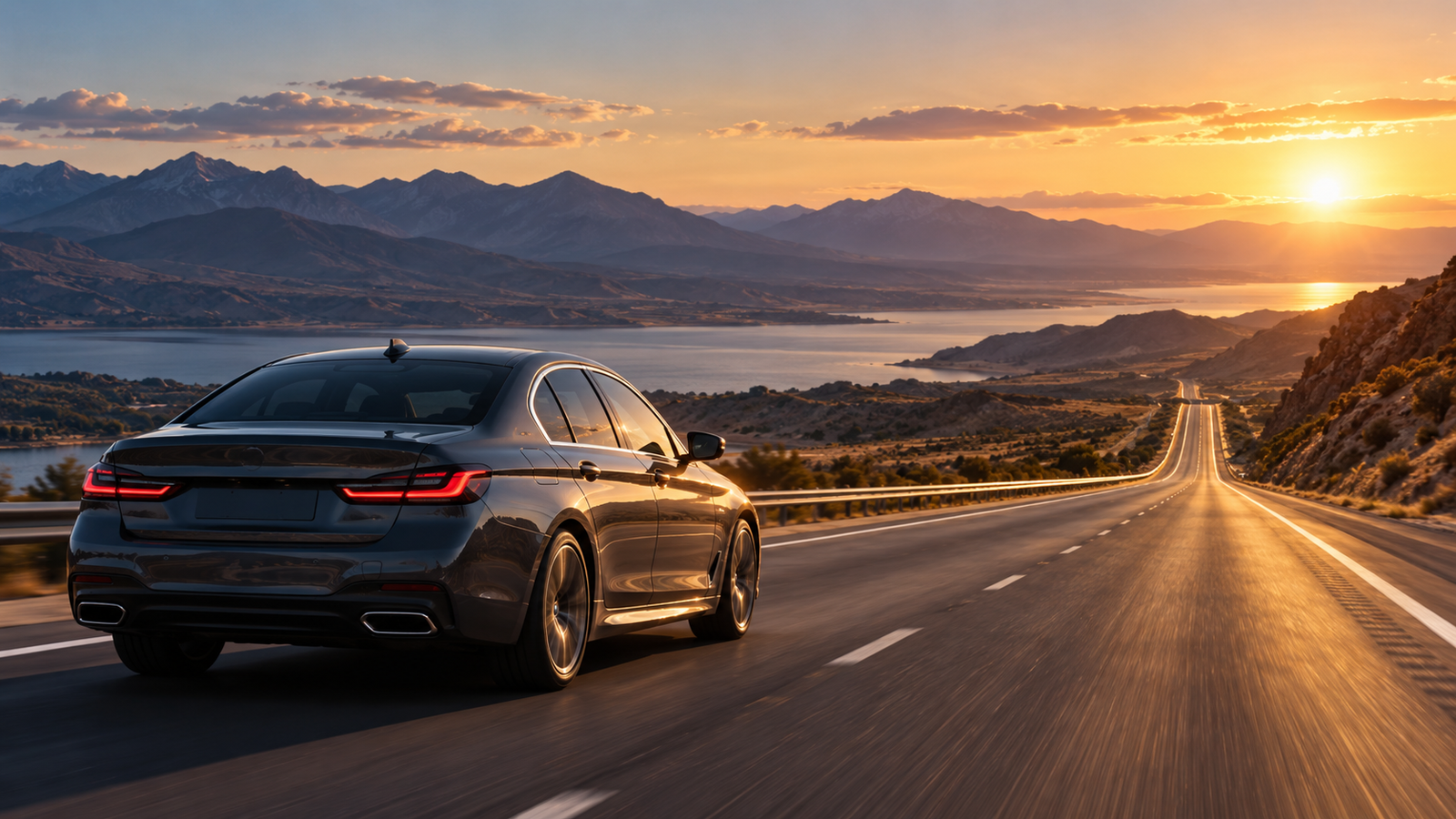
There is something strange about the way we judge cars.
We talk about horsepower.
Acceleration.
Top speed.
Lap times.
Numbers that can be measured in seconds, miles per hour and kilowatts.
But take the same car and drive it for six hours, and suddenly the conversation changes.
The seat matters.
The suspension matters.
The noise inside the cabin matters.
So does the way the car behaves when the road becomes monotonous and the destination is still hundreds of miles away.
This is why the best cars for long drives aren’t always the fastest.
A car can be incredibly quick and still become tiring after several hours.
Another car might have half the performance but leave you feeling relaxed when you finally arrive.
Long-distance driving reveals a different side of a car.
And sometimes, it is the less obvious qualities that make a vehicle genuinely enjoyable over a long journey.
Speed Is Easy to Measure. Comfort Isn’t.
Performance numbers are attractive because they are simple.
Zero to 60.
Quarter-mile time.
Horsepower.
Torque.
Top speed.
You can put two cars next to each other and immediately compare them.
Comfort does not work that way.
You cannot easily describe what a seat feels like after four hours.
You cannot reduce cabin quietness to a single number that explains how relaxing the interior feels.
You cannot completely measure the confidence created by a car that tracks straight and absorbs imperfections without drama.
These things reveal themselves slowly.
That is why a short test drive can sometimes be misleading.
A car may feel exciting during the first 20 minutes.
After three hours, you may feel very differently.
For a long drive, the question is not simply:
How fast is it?
The better question is:
How does it make you feel after the road has been running beneath you for hours?
That is a much harder question to answer.
But it is also much more interesting.
1. A Great Long-Distance Car Should Make You Forget the Distance
The ideal road-trip car almost disappears.
You settle into the seat.
Set the navigation.
Choose your music.
Find a comfortable cruising speed.
And then you simply drive.
There is no constant battle with the steering.
No harsh suspension reminding you about every crack in the road.
No excessive wind noise drowning out the music.
No uncomfortable seating position forcing you to move around every few minutes.
The car simply does its job.
This does not mean the car has to be boring.
Quite the opposite.
The best cars for long drives can have plenty of character.
But their character does not constantly demand your attention.
They give you enough comfort and stability to settle into the rhythm of the journey.
And that rhythm is one of the things that makes long-distance driving special.
2. Ride Quality Matters More Than You Expect
Roads are rarely perfect.
Even a smooth highway can contain expansion joints, rough patches, changes in pavement and unexpected bumps.
A stiff suspension may feel impressive on a winding road.
It may make the car feel sharp and responsive.
But over hundreds of miles, constant impacts can become exhausting.
A good long-distance car needs a suspension that understands compromise.
It should control the vehicle without transmitting every imperfection directly into the cabin.
That does not mean a soft suspension is always better.
Too much body movement can also become tiring.
The ideal setup gives you a sense of control while filtering out the unnecessary punishment.
You want to feel connected to the road without feeling every inch of it.
That balance is one of the reasons some cars feel naturally suited to long journeys.
They make rough sections feel like minor interruptions rather than major events.
3. Highway Stability Is a Quiet Superpower
One of the most underrated qualities in a car is how naturally it behaves at highway speed.
A good long-distance car feels settled.
The steering does not require constant correction.
The vehicle does not feel nervous when the road opens up.
Crosswinds do not completely change its character.
And when traffic moves around you, the car remains composed.
None of this sounds particularly exciting.
But after several hours, it becomes extremely important.
A stable car reduces the amount of mental effort required to drive.
You can concentrate on what is happening ahead instead of constantly managing the vehicle underneath you.
That is particularly valuable on long stretches of highway where the road may appear simple but demands continuous attention.
The best cars for long-distance driving often have this quality.
They feel calm.
And calm is underrated.
4. A Quiet Cabin Turns the Car Into a Private Space
There is a moment during a long drive when the outside world starts to feel distant.
The road continues ahead.
The scenery changes.
The cabin becomes its own little environment.
This is where a quiet interior becomes more than a luxury.
It becomes part of the experience.
With less tire and wind noise, conversation becomes easier.
Navigation instructions are easier to hear.
And music becomes more enjoyable.
This matters especially for drivers who see music as part of the journey.
A long highway can create a completely different atmosphere when paired with the right soundtrack.
Progressive trance.
Ambient electronic music.
A carefully selected playlist.
The road becomes the visual rhythm while the music provides the emotional rhythm.
That connection between music and movement is something we explored in Progressive Trance and the Driving Experience.
The quieter the environment, the more naturally those two experiences can blend together.
5. Seats Are Part of the Car’s Engineering
People often talk about engines and suspension as if they are the most important parts of a car.
On a long journey, your seat might have a stronger influence on your experience.
A good seat should support your body without creating pressure points.
It should give you enough adjustment to find a natural position.
Your lower back should feel supported.
Your legs should be relaxed.
Your arms should reach the steering wheel without forcing your shoulders forward.
These details may seem insignificant during a short drive.
They become much more obvious after several hours.
This is why the best cars for long drives tend to have a driving position that feels natural rather than dramatic.
You should not have to think about where your body is.
You should simply be comfortable.
The seat should disappear from your attention.
And when that happens, you can focus on the road.
6. Range Creates Freedom
Long-distance driving is also about freedom.
You do not want every decision to revolve around the next fuel station or charging stop.
For a gasoline-powered vehicle, useful range depends on both fuel economy and tank capacity.
For an EV, charging speed, charging availability and route planning become important parts of the equation.
Neither approach is automatically better for every journey.
What matters is how easily the vehicle fits your route.
A car with plenty of usable range gives you more flexibility.
You can stop because you want coffee.
Because you found an interesting viewpoint.
Because there is a small town worth exploring.
Not simply because the dashboard says you have to refuel or recharge immediately.
That freedom changes the character of a road trip.
The journey becomes less about managing the car and more about experiencing the road.
7. Practicality Becomes More Important After Hour Four
A long drive exposes a car’s practical weaknesses.
Where do you put the bags?
Can passengers reach their belongings?
Is there enough room for luggage?
Can everyone find a comfortable position?
Are the cupholders actually useful?
Can you easily charge your devices?
None of these questions sound exciting.
But they matter.
A car that works well for a long trip should make everyday tasks easy.
You should not have to reorganize the entire cabin every time somebody needs something.
For couples, families and groups of friends, interior flexibility can be just as important as performance.
A beautiful sports car might be perfect for two people traveling light.
A family crossing several states or countries may need something completely different.
The best road-trip car is therefore not necessarily the best car in absolute terms.
It is the car that fits the journey.
8. Technology Should Reduce Work, Not Create It
Modern vehicles can make long journeys easier.
Adaptive cruise control can reduce some of the effort involved in maintaining speed.
Navigation can help you understand upcoming turns and route changes.
Cameras can make parking unfamiliar vehicles easier.
Phone integration can keep your music and communication accessible.
But technology should remain secondary to driving.
A complicated interface can create more frustration than it solves.
The ideal system is intuitive.
You know where the important controls are.
You can change the temperature without searching through menus.
You can adjust the audio without taking your attention away from the road.
You can understand the navigation without studying the screen for too long.
The best technology does not announce itself.
It simply works.
9. Character Still Matters
After talking about comfort, quietness, stability and practicality, there is one quality we should not forget.
Character.
A car can be incredibly comfortable and still leave you cold.
A road trip is a lot of time to spend with a machine.
You hear its sounds.
You feel its steering.
You notice the way it responds to throttle inputs.
You become familiar with its personality.
That is why some cars become memorable.
It might not be because they were the fastest.
It might be because they made every kilometer feel a little more interesting.
Maybe the steering had a certain weight.
Maybe the engine had a distinctive sound.
Maybe the driving position felt perfect.
Maybe the car simply made you want to take the longer route home.
Those small qualities are difficult to measure.
But they are often what we remember.
As we explored in What Makes a Car Feel Special?, numbers are only part of the relationship between a driver and a car.
The Best Long-Drive Car Depends on the Journey
There is no universal winner.
A person driving alone across a continent has different needs from a family heading to the coast.
An enthusiast taking mountain roads wants something different from someone spending most of the journey on motorways.
An EV driver may plan around charging.
Another driver may simply want a large fuel tank and the freedom to keep moving.
The important thing is to understand what makes a great road trip car for your particular journey.
Sometimes the answer is a comfortable sedan.
Sometimes it is a wagon, SUV, grand tourer or even a sports car.
What matters is the relationship between the car and the road.
Sometimes Slower Is Better
There is a strange irony in automotive culture.
We spend so much time celebrating speed, yet some of the most enjoyable drives happen at ordinary speeds.
An empty road.
A beautiful landscape.
Good weather.
A comfortable seat.
The right song.
And nowhere you urgently need to be.
That is when driving stops feeling like transportation.
It becomes an experience.
A great long-distance car understands that.
It does not need to constantly prove what it can do.
It simply makes you want to continue.
And that may be the most important quality of all.
Because the best cars for long drives aren’t always the fastest.
Sometimes they are the ones that make you wish the journey was a little longer.
Cars. Roads. Music.
The Experience of Driving.