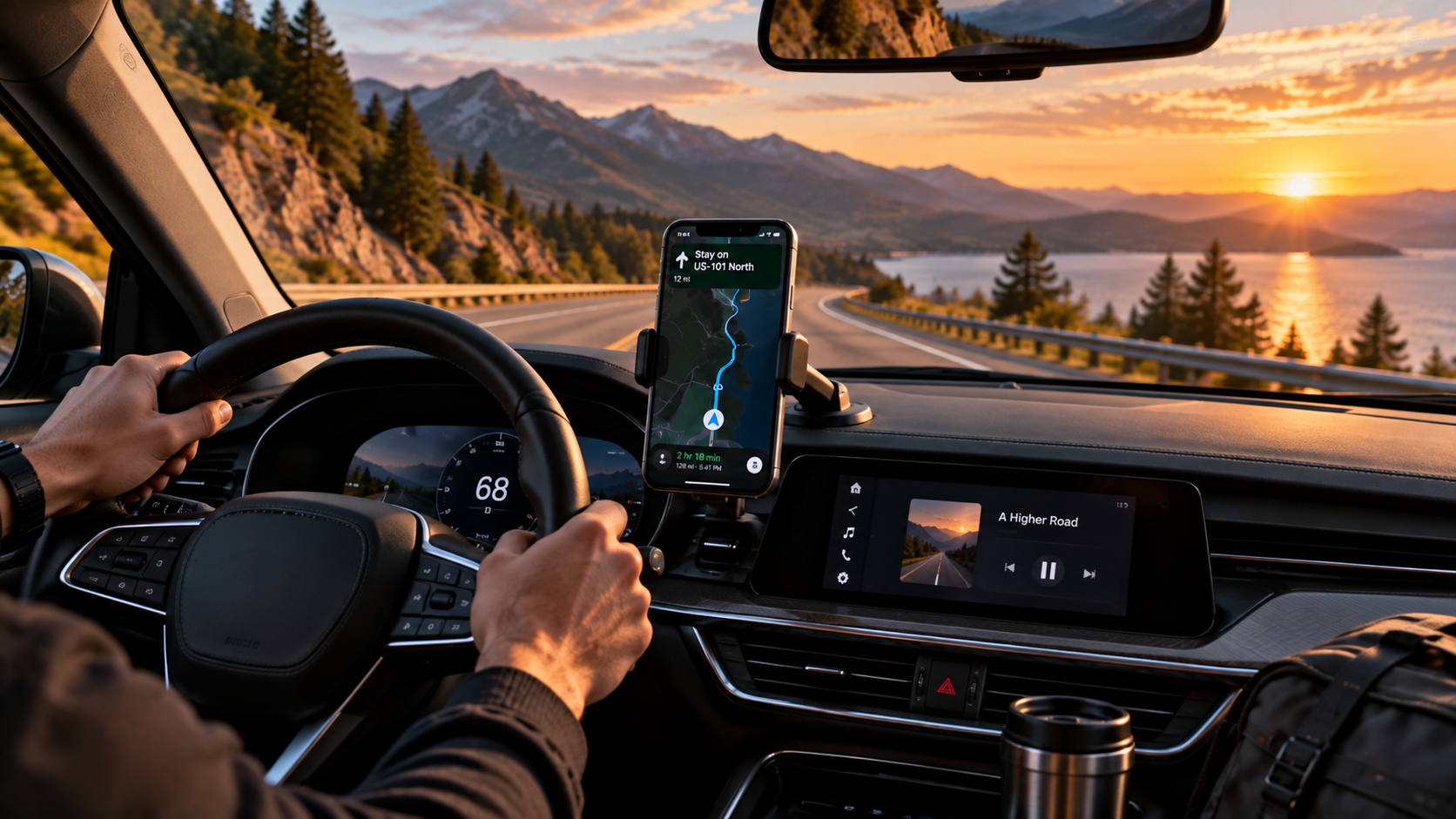
A phone has become one of the most useful tools in a modern car.
Navigation, traffic information, weather, roadside assistance and travel planning can all fit inside a device that sits in your pocket.
But there is an important difference between having a phone in the car and having a phone positioned properly for driving.
That is where a good phone mount becomes useful.
The best phone mount for a road trip is not necessarily the most expensive one. It is the one that keeps the phone secure, visible when necessary and out of the driver’s hands.
Why a Phone Mount Matters on Long Drives
During a short drive, you might already know the route.
A long road trip is different.
You may need navigation for several hours, change routes because of traffic, check directions at a safe stop or follow a completely unfamiliar road.
Keeping the phone in a secure, predictable position can make those situations easier to manage.
The purpose of a phone mount is not to encourage drivers to interact with their phones.
Quite the opposite.
A properly positioned mount should reduce unnecessary handling and allow important navigation information to be viewed with minimal distraction.
The Wrong Phone Mount Can Become an Annoyance
Not every phone holder works well in every car.
A mount that looks perfect in a product photo may block an air vent, obstruct part of the windshield or sit too far away from the driver’s normal field of view.
Some mounts also become loose over time.
Others may struggle with heavier phones, protective cases or rough roads.
That is why choosing a phone mount should start with the vehicle rather than the product advertisement.
1. Start With the Mounting Location
There are several common ways to mount a phone inside a car.
- Dashboard mounts
- Windshield mounts
- Air-vent mounts
- CD-slot mounts on compatible vehicles
- Center-console or custom mounts
Each approach has advantages and disadvantages.
A dashboard mount can provide a clean viewing position without occupying the windshield.
A windshield mount can offer flexibility in positioning but may obstruct visibility if placed incorrectly.
An air-vent mount is compact, although it can interfere with airflow or may not work well with every vent design.
The right location depends heavily on the layout of your car.
2. Visibility Is More Important Than Appearance
A phone mount can look perfectly integrated into the dashboard and still be positioned badly.
The driver should not have to look far away from the road to see basic navigation information.
At the same time, the phone should not block important parts of the windshield.
This is particularly important when driving unfamiliar roads, where the driver already needs to pay attention to signs, lane markings, traffic and changing road conditions.
A clean mounting position is more important than having the phone directly in front of your face.
3. Stability Matters
A phone holder that moves every time the car hits a bump quickly becomes frustrating.
Look for a mount with a stable connection to the vehicle and a secure grip on the phone.
The type of road matters too.
A mount that works perfectly on smooth city streets may behave differently on rough roads or winding mountain routes.
For road trips, stability should be one of the first things you consider.
4. Check Phone Compatibility
Phone sizes have changed considerably over the years.
Some drivers also use thick protective cases, wallet cases or external battery accessories.
Before choosing a mount, check the supported phone dimensions and clamp range.
A holder that technically supports your phone but struggles with its case is not particularly useful.
If multiple people use the same vehicle, consider whether the mount needs to accommodate different phone sizes.
5. One-Handed Operation Sounds Useful, But Think About When You Use It
Many phone mounts advertise easy one-handed insertion and removal.
That can be convenient.
But convenience should not be confused with something you should do while driving.
Mount or remove the phone while the vehicle is safely stopped.
Once the journey begins, the mount’s job is to keep the phone in place rather than provide another reason to interact with it.
6. Magnetic Mounts Can Be Very Convenient
Magnetic mounts have become popular because they can make attaching a phone extremely quick.
They can also create a clean-looking installation with minimal hardware around the device.
However, compatibility depends on the phone and case.
Some systems require a compatible magnetic ring or case, while others rely on built-in magnetic hardware.
Before choosing one, make sure the magnetic connection is designed for your particular phone setup.
7. Wireless Charging Can Add Convenience
Some phone mounts combine mounting with wireless charging.
This can be useful on long trips because navigation can consume significant battery power.
Instead of connecting and disconnecting a cable repeatedly, a compatible phone can charge while sitting in the mount.
However, wireless charging is not essential.
A simple mount combined with a reliable cable can perform the basic job just as well.
Do not choose a more complicated system simply because it has more features.
8. Heat Can Become a Problem
Navigation and charging can generate additional heat inside a smartphone.
That becomes more noticeable when the vehicle is sitting in strong sunlight.
A mount positioned directly in sunlight may expose the phone to unnecessary heat.
This is another reason mounting position matters.
During hot weather, pay attention to the phone’s temperature and avoid placing it where direct sunlight and charging combine to create excessive heat.
9. Cable Management Makes a Difference
A good phone mount can still look messy if the charging cable is hanging across the dashboard.
Try to route the cable so it does not interfere with the steering wheel, gear selector, pedals or other controls.
Small cable clips can help keep everything organized.
This is particularly useful on long journeys because a loose cable becomes much more noticeable after several hours.
10. Don’t Mount the Phone Somewhere Dangerous
The mounting position should never interfere with vehicle controls, visibility or safety equipment.
A phone should not cover critical parts of the windshield or block important instruments.
It should also never be positioned where it could interfere with an airbag deployment path.
The exact safe locations vary between vehicles, so the owner’s manual is a useful reference when deciding where to install accessories.
A Phone Mount Should Reduce Distraction
This is the most important point.
A phone mount is not a hands-free license to use your phone continuously while driving.
Its main benefit is that it gives navigation a predictable location.
Set your destination before leaving whenever possible. Start your playlist before the vehicle moves. Make major route changes while safely stopped.
The less interaction required while driving, the better.
Phone Mounts and the Modern Road Trip
Road trips have changed dramatically compared with previous generations.
Paper maps have largely been replaced by navigation apps. Physical travel guides have moved into smartphones. Traffic information can update in real time.
Technology can make long-distance driving easier.
But the road itself has not changed.
You still need to read signs, understand the road, watch traffic and remain aware of your surroundings.
Technology should support that experience rather than dominate it.
The Best Position Depends on Your Car
There is no single phone-mount position that works perfectly for every vehicle.
A sports car with a low dashboard may require a different solution from a large SUV.
A classic car with minimal electronics may need a completely different approach from a modern vehicle with a large integrated infotainment display.
This is one reason it is worth looking at the interior of your own car before shopping.
Identify where the phone can sit without blocking anything important.
Then choose the mounting system that fits that location.
What About Cars With Built-In Navigation?
If your car already has excellent built-in navigation, you may not need a phone mount at all.
Some modern vehicles provide navigation, traffic information and smartphone integration through the factory infotainment system.
In those cars, a phone mount may still be useful for other purposes, but it becomes less essential.
This is an important reminder that accessories should solve actual problems.
If your car already solves the problem, buying another device may add clutter rather than value.
A Good Phone Mount Fits Into the Driving Experience
The best accessories are the ones you stop noticing after they are installed.
A good phone mount should become part of the environment.
It holds the phone.
It stays stable.
It keeps navigation visible when needed.
And then it disappears from your attention.
That is exactly what you want from an accessory during a long drive.
Consider the Entire Road-Trip Setup
A phone mount is only one small part of preparing a car for a long journey.
As we covered in 10 Car Accessories That Make Long Drives Easier, useful equipment can also include chargers, tire inflators, emergency equipment and storage solutions.
The key is not to buy everything.
It is to build a setup around the way you actually travel.
A driver who spends most weekends exploring mountain roads will have different requirements from someone who mainly drives between cities on major highways.
Think About Your Driving Before You Buy
Before choosing a phone mount, ask yourself a few simple questions.
- Where can I mount it without blocking visibility?
- Will it hold my phone securely?
- Does it work with my phone case?
- Do I need wireless charging?
- Will the position work on long highway drives?
- Can the cable be routed safely?
Those questions are more useful than simply searching for the product with the highest number of features.
The Right Accessory Should Make the Road Easier
Long-distance driving is already a complex activity.
The road changes. Traffic changes. Weather changes. The scenery changes.
Your accessories should make the experience simpler, not add another layer of complexity.
A well-designed phone mount can do exactly that.
It gives navigation a stable place. It keeps the cabin organized. It reduces unnecessary handling.
Then you can put your attention back where it belongs.
On the road.
Technology Should Serve the Journey
A smartphone can be an incredibly useful road-trip companion.
But the best journeys are not measured by how much technology you use.
They are measured by the places you see, the roads you remember and the experiences created along the way.
Use the technology where it helps.
Then let the road take over.
Because ultimately, a road trip is still about the same three things:
Cars.
Roads.
Music.
The experience of driving.