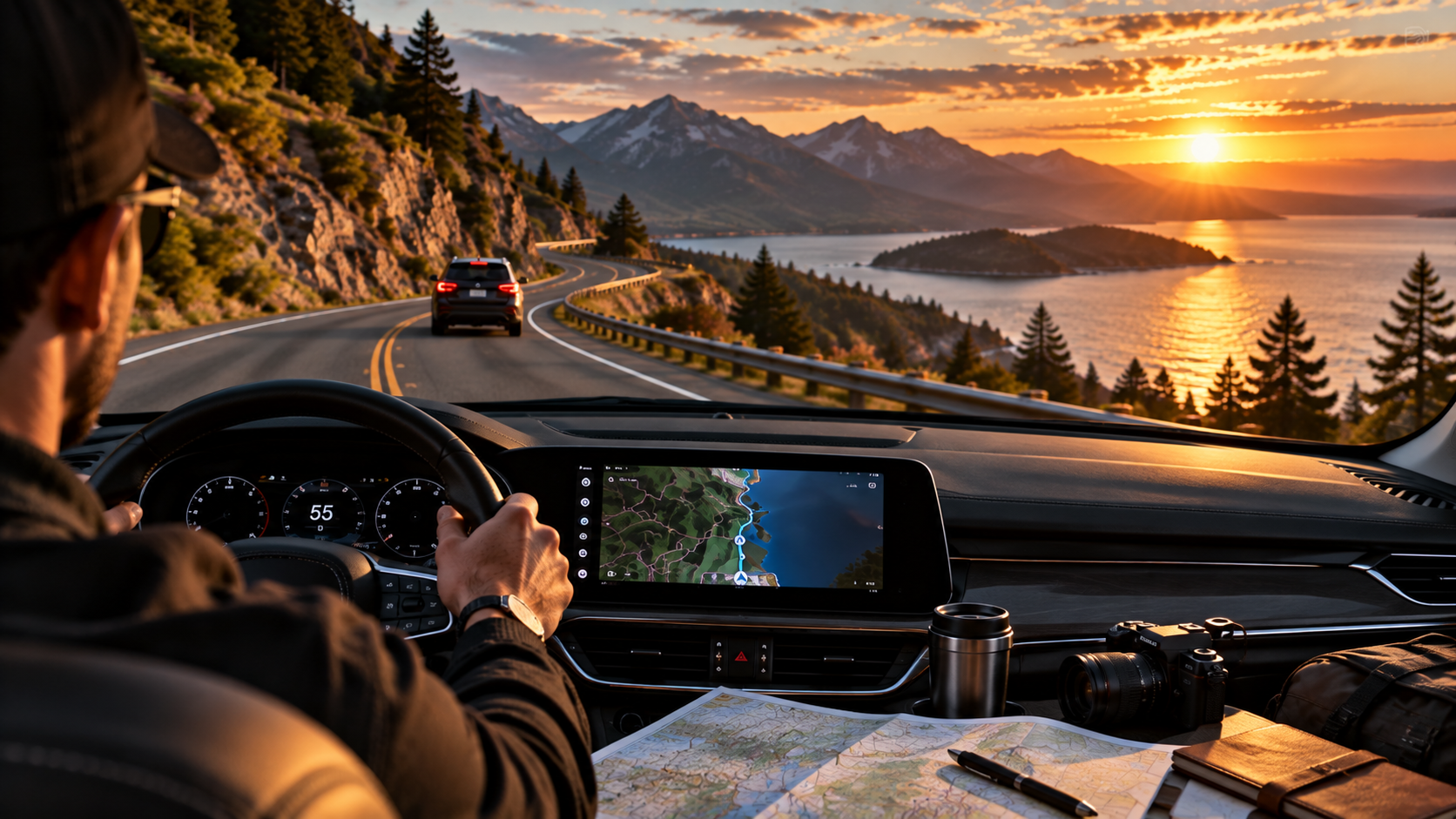
A road trip can be carefully planned and still feel completely spontaneous.
That is the balance worth finding.
Plan too little and you may spend the journey worrying about fuel, accommodation, traffic or whether the next road actually goes where you think it does.
Plan too much and the trip can start feeling like a schedule that happens to take place inside a car.
The best road trip routes usually leave enough structure to keep the journey comfortable while preserving enough flexibility for the unexpected.
Start With the Experience, Not the Destination
The first question should not always be, “Where are we going?”
Ask what kind of driving experience you want.
Do you want long stretches of highway?
Mountain roads?
Coastal scenery?
Small towns?
Night driving?
A combination of everything?
The answer changes the route.
A route designed purely around arrival time can be very different from one designed around the experience of driving.
As Why Some Roads Are More Enjoyable Than Others explores, road design, scenery, elevation, surface and atmosphere can completely change how a journey feels.
1. Decide How Much Time You Really Have
Before choosing the route, establish the actual amount of time available.
A weekend trip should be planned differently from a two-week road trip.
Do not count only the number of days between departure and return.
Consider how many hours you realistically want to spend driving each day.
A theoretical eight-hour driving day may look efficient on a map, but it leaves less room for fuel stops, meals, photography, unexpected traffic and simply enjoying the road.
The route should fit the trip.
Not the other way around.
2. Choose a General Direction First
It is often easier to begin with a broad direction instead of immediately creating a detailed itinerary.
For example:
- Head toward the coast
- Cross a mountain region
- Follow a major scenic highway
- Connect several interesting towns
- Drive toward a specific national park or destination
Once the general direction is established, the smaller decisions become easier.
You can then identify which roads are worth taking and which sections are mainly transportation.
3. Separate Roads From Stops
A common mistake is treating every interesting location as a mandatory stop.
That can make the itinerary unnecessarily complicated.
Instead, separate the journey into two categories.
Roads: sections you want to experience while driving.
Stops: places where you actually want to leave the vehicle.
A beautiful mountain road might be the experience itself.
A viewpoint might be worth stopping for.
A small town might deserve an hour.
Keeping these categories separate makes the route easier to understand.
4. Build Around the Best Section of Road
If a route contains one particularly interesting road, build the rest of the itinerary around it.
Do not treat the best section as something you simply pass through on the way to somewhere else.
Give it enough time.
That might mean staying overnight nearby or reducing the number of other stops.
One memorable road can sometimes be worth more than five rushed attractions.
That is especially true when the purpose of the trip is driving itself.
5. Don’t Optimize Everything for Speed
Navigation apps naturally encourage the fastest route.
That is useful when you are commuting.
It is not always ideal when you are taking a road trip.
The fastest route may be a straight motorway that gets you there efficiently.
An alternative route may take longer but pass through mountains, forests, coastlines or smaller communities.
If time allows, consider whether the additional driving is actually part of the reason you are taking the trip.
A longer route is not automatically better.
But the shortest route is not automatically the most enjoyable either.
6. Know Which Roads Are Actually Drivable
A road can look attractive on a map without being suitable for your vehicle or your driving plans.
Before committing to remote or mountainous sections, check current road conditions, closures and access restrictions.
Also consider the season.
Weather can dramatically change the character of certain roads.
A route that is enjoyable during clear weather may become difficult or unavailable during storms, snow or flooding.
Good route planning includes knowing when to change the plan.
7. Plan Fuel or Charging Stops
Fuel planning should be part of the route rather than an afterthought.
For gasoline and diesel vehicles, identify suitable fuel stops before entering long stretches with limited services.
For EVs, charging locations become an important part of the route itself.
Do not plan based solely on the theoretical maximum range of the vehicle.
Speed, temperature, terrain, weather, traffic and driving style can all influence actual energy consumption.
Leaving a reasonable margin gives you more flexibility.
8. Plan Accommodation Around the Drive
If the road trip lasts several days, where you sleep can influence the route just as much as the attractions you want to visit.
Instead of choosing hotels first and forcing the driving route around them, consider the natural stopping points along the journey.
A small town halfway through an interesting route may be a better overnight stop than a larger city that requires a significant detour.
The best accommodation is not always the destination.
Sometimes it is simply the place that allows tomorrow’s drive to begin in the right location.
9. Leave Room for Unplanned Stops
This is one of the most important rules of road-trip planning.
Leave empty space in the itinerary.
If every hour has already been assigned to a destination, there is no room for discovery.
You may see a viewpoint you want to photograph.
You may find a small restaurant.
You may discover a road that looks more interesting than the one you originally planned.
Those moments are often what make a road trip memorable.
As Why Long Drives Feel Good explores, part of the appeal of a long journey comes from having enough space to experience the road rather than simply completing a schedule.
10. Consider the Car You’re Driving
The same route can feel completely different depending on the vehicle.
A comfortable luxury sedan may make long highway sections effortless.
A lightweight sports car may make winding roads more engaging.
An SUV may make a long trip easier when carrying several passengers and large amounts of luggage.
An EV introduces another consideration: charging infrastructure.
Before choosing the route, think about what your car is good at.
The best route is often the one that matches the character of the vehicle.
This connects directly to What Makes a Great Road Trip Car?.
11. Consider Who Is Coming With You
A solo driving trip can be planned around the driver’s interests.
A trip with passengers requires a different balance.
Children may need more frequent stops.
Older passengers may prefer shorter driving sections.
Friends may want time for restaurants, attractions and activities.
A route that looks perfect on paper can become exhausting if it ignores the people inside the vehicle.
Plan the journey for everyone who is traveling.
12. Don’t Forget the Return Journey
One-way planning is easy.
Return planning is where many road trips become complicated.
If you drive a scenic route to the destination, consider whether you actually want to repeat it on the way home.
Sometimes the return journey can use a completely different route.
This gives you another landscape, another set of roads and another experience without requiring a longer overall trip.
A loop can often be more interesting than simply driving back along the same path.
13. Use Major Highways Strategically
There is nothing wrong with using major highways.
In fact, they can be extremely useful for connecting the interesting parts of a journey.
Think of them as transportation corridors.
Use them to cover distance efficiently when necessary, then leave them when the more interesting roads begin.
This can create a good rhythm:
Fast section.
Scenic section.
Stop.
Fast section.
Driving-focused section.
The journey becomes varied rather than exhausting.
14. Think About Time of Day
The same road can feel completely different depending on when you drive it.
A mountain road at sunrise may have almost no traffic and beautiful light.
The same road at midday can be much busier.
A city route that is enjoyable late at night may be frustrating during rush hour.
When possible, think about the experience you want from each section and choose the time accordingly.
For drivers who enjoy nighttime atmosphere, Why Night Drives Feel Different explores how darkness can transform a familiar route.
15. Check the Weather Before Each Major Section
Weather should not be checked only once before departure.
A long road trip can cross multiple weather systems.
Mountain areas may have completely different conditions from nearby valleys.
Coastal regions can change quickly as well.
Before leaving each major section of the route, check current conditions and the forecast ahead.
If the weather becomes unsuitable, changing the route is part of good planning.
16. Download What You Need Before Leaving
Mobile connectivity is not guaranteed everywhere.
Download offline maps when your navigation service supports them.
Save important accommodation information and reservations so they remain accessible without a strong connection.
It is also useful to know the general direction of your journey rather than relying entirely on turn-by-turn instructions.
Technology should make the journey easier.
It should not become the single point of failure.
17. Don’t Plan Every Meal
Food is another area where overplanning can remove some of the fun.
For major stops, reservations may make sense.
For everything else, leave some flexibility.
A roadside café may become the best meal of the trip simply because you happened to stop there.
The same applies to coffee stops and local restaurants.
Not every decision needs to be made before the car leaves home.
18. Give Yourself a Buffer
Road trips rarely follow the exact timing shown on a navigation screen.
Traffic happens.
Construction happens.
Road closures happen.
People need breaks.
Interesting places appear.
Build some buffer into the itinerary so that a small delay does not turn into a major problem.
If you are constantly watching the clock, you may miss the reason you wanted to take the road trip in the first place.
A Simple Road Trip Planning Formula
A useful way to think about a road trip is:
Destination + Best Roads + Useful Stops + Fuel or Charging + Flexibility.
The destination gives the trip direction.
The best roads provide the driving experience.
Stops provide rest and discovery.
Fuel or charging keeps the vehicle moving.
Flexibility leaves room for everything you could not predict.
Remove any one of these and the journey can become less enjoyable.
Build the Route in Layers
Instead of creating a perfect itinerary immediately, build it in layers.
Start with the destination.
Then identify the major roads.
Then find the most interesting sections.
Then add practical stops.
Finally, add optional stops that can be skipped if the journey takes longer than expected.
This creates a route with priorities.
If time becomes limited, you already know what matters most.
Know When to Abandon the Plan
A good itinerary should be flexible enough to change.
If the weather becomes poor, take another road.
If traffic becomes extreme, find an alternative.
If everyone is tired, stop.
If you discover that the day’s planned route is too ambitious, remove a destination.
Changing the plan does not mean the trip failed.
It means the plan was doing what it was supposed to do: helping you make better decisions.
The Best Route Is Not Always the Most Efficient
Efficiency has a place in road-trip planning.
You need to reach destinations, manage fuel or charging and respect time limitations.
But a road trip is different from ordinary transportation.
The route itself is part of the experience.
A road with more curves.
A better view.
A quiet stretch of highway.
A mountain pass.
A road beside the ocean.
These things can justify taking a little longer.
Plan Enough to Relax
The real purpose of route planning is not to control every moment.
It is to remove unnecessary uncertainty.
Know where you are going.
Know where you can stop.
Know where you can refuel or recharge.
Know what roads might require extra attention.
Then leave the rest open.
Let the Road Surprise You
The most memorable road-trip moments are rarely the ones that appear perfectly inside a spreadsheet.
They happen when the road opens up.
When the weather changes.
When the sunset appears earlier than expected.
When an unfamiliar road turns out to be the best section of the journey.
Good planning creates the freedom to enjoy those moments.
It gives you enough structure to feel comfortable without removing the uncertainty that makes a road trip interesting.
The Route Is Part of the Story
A road trip is not simply a line between two points.
It is a sequence of roads, landscapes, stops, sounds and decisions.
The car becomes the space where all of those things come together.
The music changes.
The scenery changes.
The road changes.
And eventually the destination appears.
That is why the best route is not necessarily the one that gets you there fastest.
It is the one that gives you a reason to remember how you got there.
Plan the essentials.
Leave room for the unexpected.
Then drive.