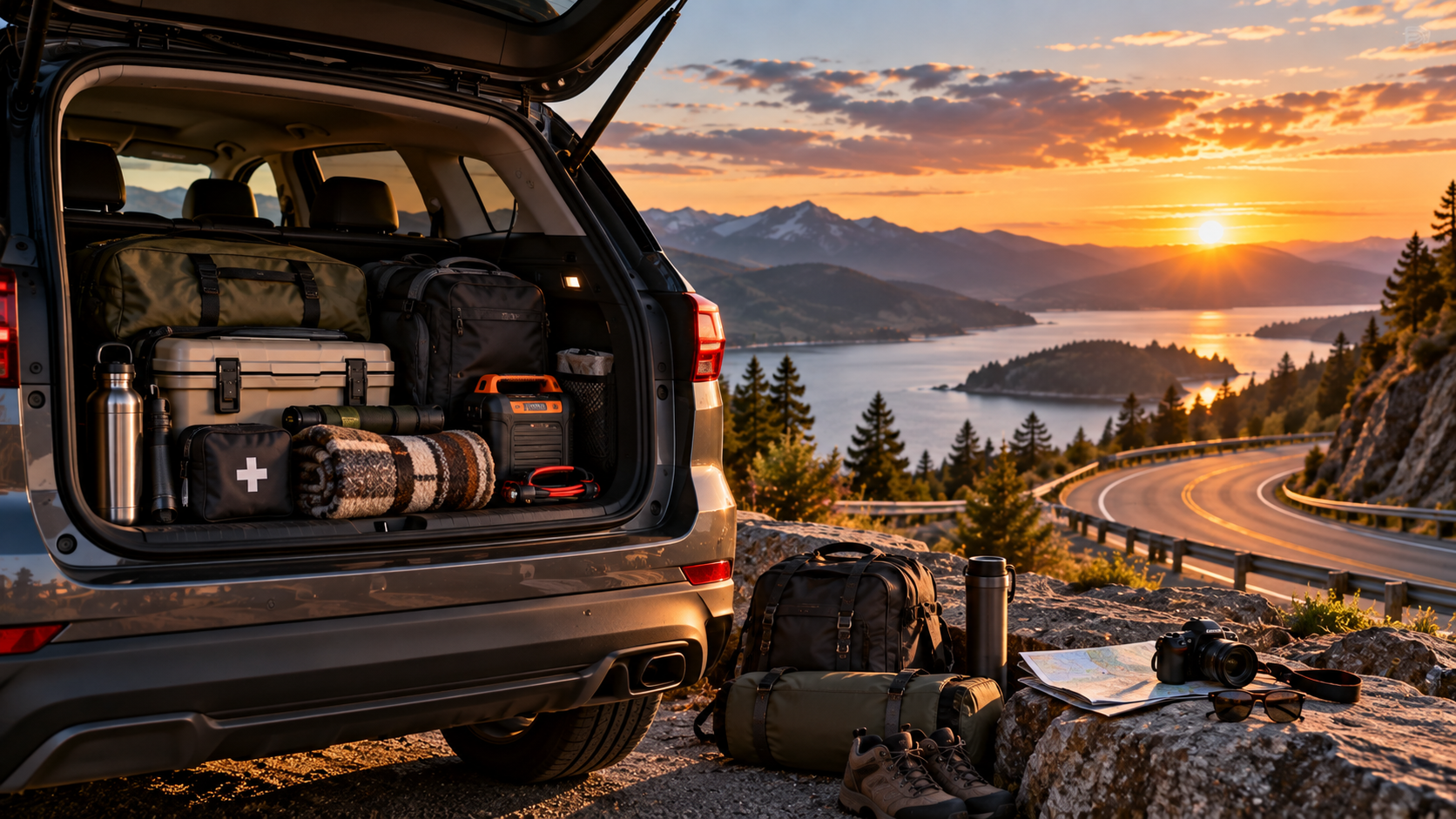
A long road trip does not require bringing everything you own.
In fact, one of the easiest ways to make a journey less enjoyable is to fill the car with things you probably will never use.
The better approach is to pack around the realities of long-distance driving: staying comfortable, keeping the car prepared, dealing with small unexpected problems and making the hours on the road easier.
The best road trip essentials are usually simple things that solve practical problems before those problems become annoying.
Why What You Pack Matters
A long drive is different from an ordinary trip across town.
You may spend several hours away from home, pass through unfamiliar areas and encounter changing weather, road conditions and traffic.
That does not mean you need a huge emergency kit or an overloaded trunk.
It simply means that a little preparation can give you more freedom to enjoy the journey.
As we explored in How to Prepare Your Car for a Long Road Trip, the vehicle itself should be checked before departure. What you bring inside the car is the next part of the equation.
1. Phone and Charging Equipment
A smartphone has become one of the most useful pieces of equipment on a road trip.
It can provide navigation, weather information, roadside assistance and access to important travel information.
But none of that is particularly useful when the battery is empty.
Bring a reliable charging cable and make sure the vehicle has a working charging connection. A portable power bank can also be useful when you are away from the vehicle for extended periods.
If you use your phone for navigation, keeping it securely mounted is also preferable to holding or handling it while driving.
The objective is not to turn the phone into another distraction. It is to make useful technology available without taking attention away from the road.
2. Water and Simple Snacks
Food does not need to become a major part of your road-trip equipment.
A bottle of water and a few simple snacks can be surprisingly useful when the next convenient stop is farther away than expected.
Choose things that are easy to store and do not create a mess inside the cabin.
Keeping water available also means you do not have to make every stop specifically because you need a drink.
The more comfortable the basic environment becomes, the easier it is to focus on the journey itself.
3. A Small First-Aid Kit
A compact first-aid kit takes up very little space and can be useful for minor situations.
You do not need a large medical bag for an ordinary road trip. A basic kit appropriate for minor cuts, scrapes and everyday travel situations is usually enough.
Keep it somewhere accessible rather than buried underneath luggage.
The purpose of carrying one is not to prepare for every possible emergency. It is simply to avoid being completely unprepared for something small.
4. Flashlight or Portable Light
A flashlight is one of those items that seems unnecessary until you actually need one.
Checking a tire after dark, looking inside the trunk or finding something that has fallen underneath the car becomes much easier with a proper light.
A compact rechargeable flashlight is easy to store and can serve several purposes during a journey.
Your phone has a flashlight too, but using a dedicated light leaves your phone available for navigation or communication.
5. Tire Inflation Equipment
Tires deserve special attention during a long road trip.
Even when a tire is not punctured, pressure can change over time and with temperature.
A portable tire inflator can be useful for checking and correcting tire pressure when you are away from a service station.
It is not a replacement for proper tire inspection or professional repair when a tire is damaged. But as part of a broader road-trip kit, it can be a practical tool.
Before relying on any emergency equipment, make sure you understand how it works and that it is compatible with your vehicle.
6. A Tire Repair Solution
Depending on the vehicle, a tire repair kit may also be worth carrying.
Some vehicles have a full-size spare tire. Others have a temporary spare. Some newer vehicles do not have a conventional spare at all.
Check what your particular vehicle provides before deciding what additional equipment you need.
A repair kit can be useful for certain types of punctures, but not every tire problem can or should be repaired on the roadside.
If the tire has major damage, the safest option may be professional assistance.
7. Jumper Cables or a Jump Starter
A weak battery can create an inconvenient situation even when the rest of the car is perfectly healthy.
Traditional jumper cables can be useful when another vehicle is available. A portable jump starter provides another option when there is no other car nearby.
Whichever solution you carry, learn how to use it before the trip.
Emergency equipment is most useful when you already understand what it does and how to operate it safely.
8. Basic Tools
You do not need a full workshop in the trunk.
A few basic tools appropriate for your particular vehicle can be enough for simple situations.
Depending on the car, this might include:
- A basic screwdriver set
- Adjustable pliers
- Work gloves
- A small wrench set
- Electrical tape
- Zip ties
These items are not intended to turn the driver into a roadside mechanic.
They simply provide options for small problems that do not require major repairs.
9. Cleaning Supplies
A few cleaning items can make a surprisingly big difference during a multi-day road trip.
Keep a small microfiber towel in the car. It can be used for cleaning the windshield, wiping dust from interior surfaces or dealing with small spills.
Wet wipes or similar basic cleaning products can also be useful.
After several hours in a car, keeping the cabin clean makes the environment feel noticeably better.
10. A Small Trash Bag
This might be one of the least exciting items on the list, but it is one of the easiest to appreciate.
Food packaging, receipts, tissues and small pieces of rubbish can quickly turn a clean cabin into a messy one.
A small reusable or disposable trash bag solves the problem immediately.
It also makes stopping at a fuel station or rest area much easier because the rubbish can be disposed of properly.
11. Comfortable Clothing
What you wear matters more when the drive lasts several hours.
Clothing that is comfortable and appropriate for the weather can make a long journey easier.
If the trip crosses different climates or includes overnight stops, keeping an extra layer in the car can also be useful.
The idea is simple: do not dress for the first thirty minutes of the journey.
Dress for the entire day.
12. A Blanket or Light Travel Layer
Cabin temperature is a surprisingly common source of disagreement on road trips.
One passenger may feel cold while another prefers a cooler cabin.
A lightweight blanket or extra layer gives passengers another option without requiring the driver to constantly adjust the climate control.
It can also become useful during rest stops or unexpected delays.
13. Sunglasses
Sunlight can become tiring during long periods of daytime driving.
A good pair of sunglasses can improve comfort when the sun is low on the horizon or when driving through highly reflective environments.
Keep them somewhere accessible so they do not become another object that requires searching through luggage.
Visibility should always come first, so use appropriate eyewear for the conditions and never compromise the driver’s ability to see the road clearly.
14. Important Documents
Before leaving, make sure the necessary driving and vehicle documents are available.
Depending on where you are traveling, this can include your driver’s license, vehicle registration, insurance information and reservation details.
Digital copies can be useful, but keeping access to important information offline can also be valuable when cellular coverage becomes unreliable.
Good preparation means not having to search through email or apps while standing somewhere without a reliable connection.
15. Navigation Backup
Modern navigation apps are extremely useful, but long road trips are a good reminder that technology is not perfect.
Download offline maps when available and know the general direction of your route.
You do not need a paper atlas covering an entire continent, but having some form of backup navigation can be useful when signal coverage disappears.
The goal is not to distrust technology.
It is to avoid becoming completely dependent on one device.
16. Music and the Right Playlist
Then there is the item that cannot really be measured in kilograms.
Music.
A long road trip without music can feel completely different from one built around a carefully selected playlist.
Some drivers prefer podcasts or audiobooks. Others want classic rock, ambient music, electronic music or progressive trance.
There is no universal answer.
The important thing is choosing something that complements the journey rather than becoming another source of distraction.
For drivers who enjoy electronic music, Progressive Trance and the Driving Experience explores why evolving electronic textures can work particularly well with the continuous movement of a long road.
17. A Good Pair of Driving Shoes
Footwear is easy to overlook.
For long drives, comfortable shoes with appropriate soles can make pedal control feel more natural.
Avoid footwear that interferes with your ability to operate the pedals safely.
This is especially important when driving a car with a manual transmission, where the left foot remains active throughout the journey.
18. Don’t Overpack the Trunk
There is a temptation to prepare for every possible scenario.
That usually leads to a trunk full of equipment that never gets used.
A better strategy is to think in categories:
- Things that keep you connected
- Things that keep you comfortable
- Things that help with minor car problems
- Things that help during unexpected delays
- Things that make the journey more enjoyable
Everything else can probably stay at home.
The Best Road Trip Gear Is the Gear You Actually Use
Road-trip preparation does not need to become an exercise in buying equipment.
In fact, many of the most useful items are things you may already own.
A charging cable. A water bottle. A flashlight. A first-aid kit. A microfiber towel. A few basic tools. A comfortable layer of clothing.
Simple things can make a long journey considerably easier.
The same philosophy applies to the car itself. The best road-trip car is not necessarily the fastest or most expensive one. It is the one that fits the journey.
As What Makes a Great Road Trip Car? explores, comfort, stability, range, practicality and character can matter far more once the drive stretches into several hours.
Pack Less. Prepare Better.
The goal of packing for a long road trip is not to eliminate every possible inconvenience.
That is impossible.
The goal is to make the common problems easier to handle while leaving enough space for the things that make the journey enjoyable.
A well-prepared car should still feel like a car, not a mobile storage unit.
Leave room for luggage. Leave room for unexpected discoveries. Leave room to stop somewhere interesting and bring something home.
Because the best road trips are rarely remembered for how perfectly everything went.
They are remembered for the road, the scenery, the conversations, the music and the moments that were never on the original plan.
Pack what you need.
Then leave some space for the experience.