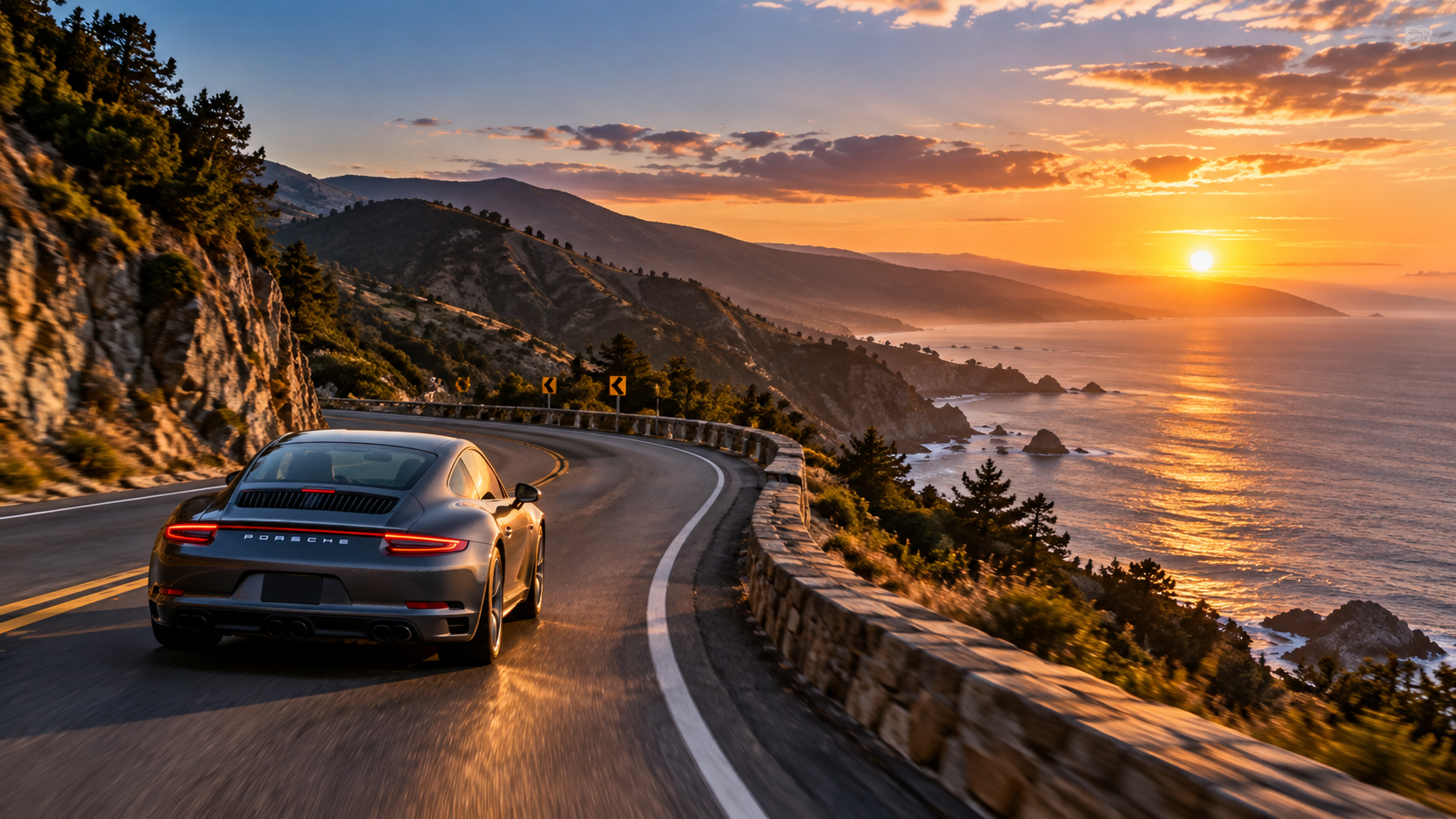
Some roads are simply better to drive than others.
Not necessarily because they are faster.
Not because they have more lanes, better signs or higher speed limits.
Sometimes a road becomes memorable for reasons that are difficult to explain.
Maybe it is the way the landscape opens up around a long corner.
Maybe it is the rhythm of a series of bends.
Maybe it is the way sunlight moves across the road in the late afternoon.
Or maybe it is simply the feeling that there is nowhere else you need to be.
This is one of the most interesting things about driving.
The quality of a journey is not determined entirely by the car.
The road itself becomes part of the experience.
And some roads seem to understand how to make you want to keep going.
The Road Has Its Own Rhythm
A straight highway creates one kind of rhythm.
A winding mountain road creates another.
A coastal road creates something completely different.
The driver responds to each one.
On a straight road, the rhythm comes from distance and consistency.
You settle into a cruising speed and watch the landscape gradually change.
On a winding road, the rhythm becomes more active.
You look ahead.
You position the car.
You turn.
You accelerate.
Then another corner appears.
The process repeats.
A good road creates a sequence that feels natural.
You are not fighting the road.
You are responding to it.
That feeling can make even a relatively ordinary car more enjoyable.
1. Curves Give the Driver Something to Do
There is a reason winding roads are so popular with driving enthusiasts.
They require participation.
A straight road can become almost passive after several hours.
A sequence of corners keeps your attention connected to the road.
You begin to read what is coming next.
You notice how quickly the corner tightens.
You feel the weight of the car move.
You adjust the steering.
You find the right moment to accelerate again.
None of this requires excessive speed.
In fact, some of the most enjoyable roads are the ones where you can experience the rhythm without driving aggressively.
The enjoyment comes from interaction.
The road asks a question.
The car responds.
You respond to both.
2. Scenery Changes the Entire Experience
A road can be technically excellent and still feel ordinary if the environment around it is forgettable.
Then there are roads where the scenery becomes part of the reason to drive.
Mountains appear in the distance.
A coastline follows the road.
Forest closes in on both sides.
Open desert stretches toward the horizon.
The landscape changes how the road feels.
A simple bend becomes more memorable when you can see a valley opening beyond it.
A long straight becomes more interesting when the road disappears toward distant mountains.
The scenery provides context.
It gives the journey a sense of place.
This is why the same car can feel completely different on different roads.
The machine has not changed.
The environment has.
3. Road Surface Matters More Than People Think
Driving enthusiasts often talk about corners, but the surface beneath the tires can be just as important.
A smooth road allows the car to communicate clearly.
You can feel what the tires are doing.
The steering feels more predictable.
The suspension can work naturally.
A rough or broken surface changes everything.
You become more cautious.
You start avoiding imperfections.
The rhythm disappears.
This does not mean a perfect road is always the most interesting road.
Sometimes imperfections become part of the character.
But a road that allows the car and driver to work together naturally is usually more enjoyable.
It becomes easier to focus on the journey rather than managing the surface.
4. Elevation Makes a Road Feel Alive
There is something special about climbing a road.
The horizon changes.
The view expands.
The engine works differently.
Then eventually the road reaches the top.
For a moment, everything opens up.
After that comes the descent.
The experience changes again.
Elevation gives a road progression.
It creates a beginning, a middle and a sense of arrival.
This is one reason mountain roads can become destinations in themselves.
You are not simply traveling from one place to another.
The road creates an experience between those places.
5. Traffic Can Change Everything
A road that feels magical early in the morning can feel completely different during the afternoon.
Traffic changes the rhythm.
You have fewer opportunities to choose your own pace.
You spend more time watching other vehicles.
Overtaking becomes part of the experience.
Suddenly the road feels less like yours.
This is why timing can be just as important as location.
An otherwise ordinary road can become memorable when you drive it at the right time.
Early morning light.
Late afternoon.
A quiet weekday.
A cool evening.
The road has not changed.
But your experience of it has.
6. Weather Gives the Same Road a Different Personality
Weather is another variable that can completely transform a drive.
Sunshine makes a road feel open and energetic.
Clouds can make the landscape feel dramatic.
Rain changes the reflections and the relationship between the car and the road.
Fog can make familiar surroundings feel unfamiliar.
Snow can transform the entire landscape.
Of course, changing weather also changes driving conditions.
Safety always comes first.
But from an atmospheric perspective, weather is one of the reasons a road can feel different every time you return.
The same route can produce completely different memories.
7. The Best Roads Give You Time to Look Around
Driving requires attention.
That does not mean you cannot appreciate the environment.
Some roads naturally create moments where the landscape becomes part of the journey.
A long straight allows you to see far ahead.
A high viewpoint reveals the road you have just traveled.
A coastal section places the horizon beside you.
These moments create memories.
They are the visual equivalent of a great song appearing at exactly the right moment.
And just like music, scenery can become permanently connected to a particular drive.
8. The Car and the Road Should Match
Not every car feels right on every road.
A large luxury sedan may feel perfect on a long highway.
A lightweight sports car may feel more engaging on a winding mountain route.
An SUV might make more sense when the road becomes rough or the journey includes several passengers.
This does not mean one type of car is universally better.
It means the relationship between the car and the road matters.
The best combination is often the one where the car’s strengths complement the road’s character.
That is part of what makes the best cars for long drives so interesting to discuss.
The answer depends on where the road takes you.
9. Sometimes the Best Road Is the One You Did Not Plan to Take
One of the great pleasures of driving is discovering something unexpected.
You see a sign pointing toward a small town.
You notice a road climbing into the hills.
You realize the scenic route will take another thirty minutes.
And you decide to take it.
That decision is rarely about efficiency.
It is about curiosity.
Road trips create space for that kind of decision.
There is no reason every journey needs to be optimized to the minute.
Sometimes the longer route becomes the better memory.
This is one of the ideas behind The Art of the Long Drive.
The journey itself can be worth extending.
Why Night Can Transform a Familiar Road
A road you know during daylight can become almost unrecognizable after dark.
The landscape disappears.
Streetlights become patterns.
Headlights create a moving tunnel through the darkness.
Traffic lights and illuminated signs become the dominant visual elements.
The experience becomes more intimate.
This is why night drives feel different.
The road is still the same physical route.
But your perception of it changes completely.
Night also changes the relationship between the driver and the cabin.
The outside world becomes quieter and more distant.
Music becomes more prominent.
The dashboard becomes part of the visual atmosphere.
For many drivers, that combination creates some of the most memorable drives of all.
The Road Becomes Part of the Memory
Ask someone about their favorite drive and they may not remember every detail of the car.
They may remember the road.
The mountain in the distance.
The coastline.
The sunset.
The rain.
The song playing through the speakers.
The person sitting beside them.
The feeling of having nowhere else to be.
That is what makes driving different from simply traveling.
The road becomes part of the memory.
And sometimes the road itself becomes the reason you remember the journey.
Why Some Roads Make You Want to Keep Driving
The best roads do not necessarily demand speed.
They create rhythm.
They provide scenery.
They allow the car to feel natural.
They give the driver enough engagement without creating unnecessary stress.
They offer moments of discovery.
And they leave enough space for the journey to become something more than transportation.
That may be the real reason some roads feel better than others.
They make driving feel effortless and meaningful at the same time.
You reach the destination eventually.
But for a while, you stop caring about how far away it is.
You simply keep driving.
And sometimes, that is exactly what we are looking for when we get behind the wheel.
Cars. Roads. Music.
The Experience of Driving.