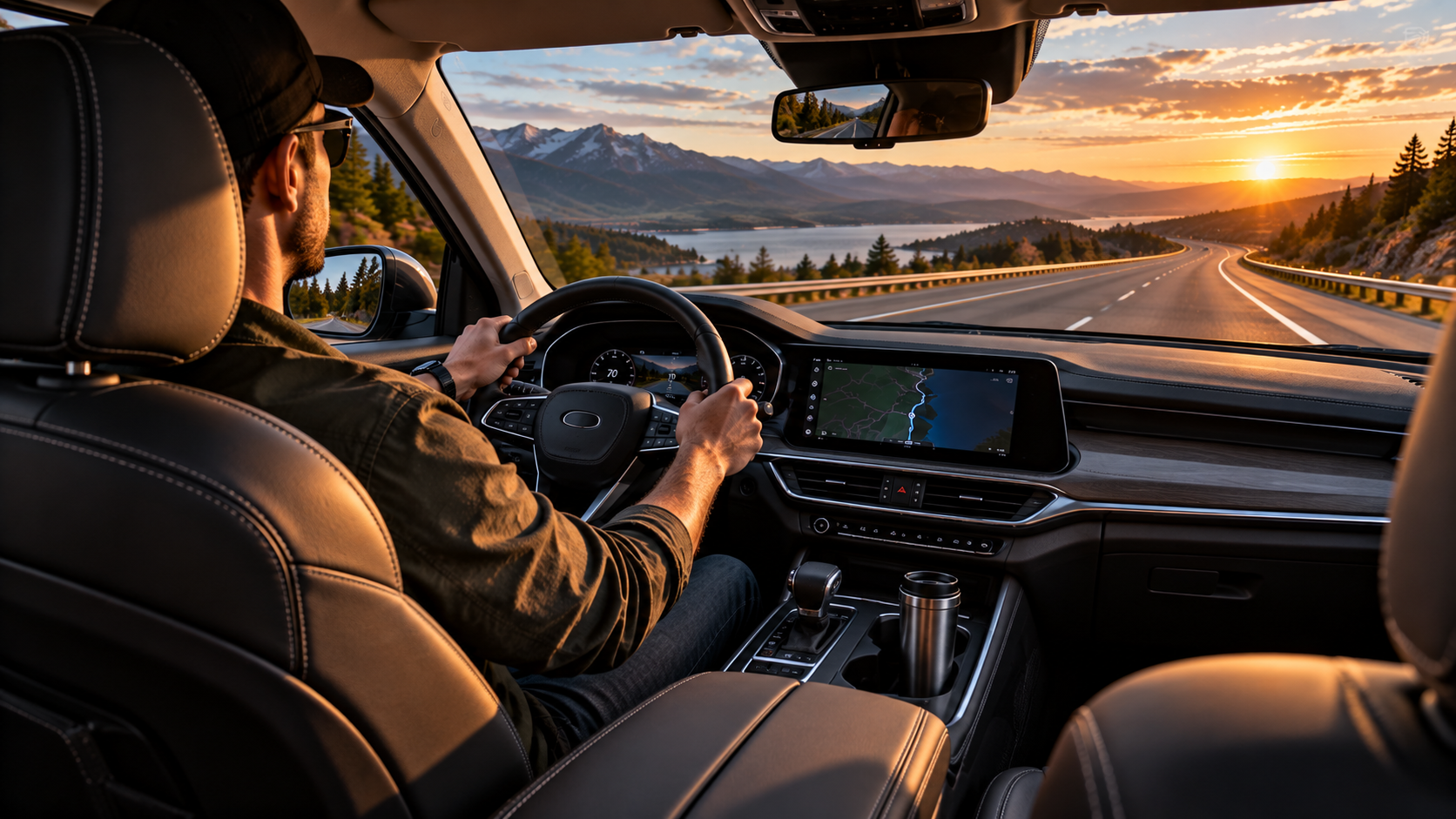
You can have a powerful engine, a quiet cabin and a beautiful road ahead, but if the driver’s seat becomes uncomfortable after an hour, the entire journey changes.
Car-seat comfort is easy to underestimate because most seats feel perfectly acceptable during a short drive.
It is only after several hours that the differences become obvious.
Pressure points appear. Your back starts asking for a different position. Your legs feel tired. You begin shifting around in the seat.
That is why the best car seat for long drives is not necessarily the softest one or the most expensive one.
It is the seat that supports the driver properly while allowing a natural and sustainable driving position.
Why Seat Comfort Matters on a Long Drive
Driving for several hours is a very different experience from commuting for twenty minutes.
The driver remains in essentially the same position for a long period while continuously controlling the vehicle.
Small ergonomic problems can therefore become increasingly noticeable.
A seat that feels comfortable when you first sit down may not feel comfortable after three or four hours.
This is one reason making a long road trip comfortable requires attention to more than just the mechanical condition of the car.
1. Start With Adjustability
A seat cannot be comfortable for everyone if it cannot be adjusted to fit different body shapes.
Useful adjustments can include:
- Seat height
- Seat distance from the pedals
- Seatback angle
- Lumbar support
- Headrest position
- Seat cushion angle
- Steering-wheel position
Not every car offers all of these adjustments.
That does not necessarily mean the seat is uncomfortable.
What matters is whether the available adjustments allow the driver to establish a natural position.
Before considering an aftermarket cushion or support product, use the adjustments already built into the vehicle.
2. Look for Proper Lower-Back Support
The lower back is one of the areas that can become noticeable during long periods of sitting.
A seat with useful lumbar adjustment allows the driver to change the amount of support rather than simply accepting one fixed shape.
The correct position will vary between drivers.
Too little support may leave the lower back feeling unsupported, while excessive support can create uncomfortable pressure.
The goal is a natural posture that does not require constant repositioning.
3. Pay Attention to the Seat Cushion
The bottom cushion has an important job.
It supports your body while also allowing your legs to interact comfortably with the pedals.
A cushion that is too short may provide insufficient support under the thighs.
A cushion that is too long can interfere with comfortable leg movement for some drivers.
Firmness also matters.
A very soft seat may feel luxurious for the first few minutes but does not automatically provide better long-distance support.
Likewise, a very firm seat is not necessarily uncomfortable if its shape distributes pressure effectively.
4. Check the Seat Height
Seat height changes your relationship with the steering wheel, pedals, dashboard and road.
Some drivers prefer a lower seating position because it creates a more connected feeling with the car.
Others prefer a higher position because it provides a broader view and easier entry and exit.
Neither approach is automatically correct.
The important thing is finding a position where you can see clearly and control the vehicle without unnecessary strain.
5. Don’t Ignore the Steering Wheel
Seat comfort cannot be considered separately from steering-wheel position.
If the steering wheel is too far away, you may find yourself leaning forward.
If it is too close, your arms may become unnecessarily bent.
Modern vehicles with adjustable steering columns make it easier to balance the relationship between the seat and steering wheel.
Adjust both together.
The correct driving position is a system rather than a single setting.
6. Headrest Position Matters Too
The headrest is not simply a comfort accessory.
It is part of the vehicle’s occupant-protection system.
Adjust it according to the vehicle manufacturer’s guidance rather than removing or replacing it simply to create a different seating position.
A comfortable driving position should still maintain the safety features designed into the seat.
7. Seat Materials Can Change the Experience
Leather, fabric, synthetic materials and other upholstery types can feel very different during a long journey.
Material affects how the seat feels against your body, how it handles temperature and how easy it is to maintain.
But material alone does not determine comfort.
A beautifully upholstered seat can still have poor ergonomics, while a simple fabric seat can be extremely comfortable.
Shape and support generally matter more than appearance.
Why the Softest Seat Is Not Always the Best
Softness is an easy thing to notice.
Sit down and the seat immediately feels comfortable.
Long-distance comfort is more complicated.
The seat needs to support the body consistently without creating excessive pressure in particular areas.
This is why a well-designed firm seat can sometimes feel better after several hours than a very soft one.
Comfort should be evaluated over time, not just during the first few minutes.
What About Aftermarket Seat Cushions?
Aftermarket cushions and lumbar-support products can be useful for some drivers.
They may change the angle or support provided by an existing seat.
However, adding something to a vehicle seat also changes the original seating position.
That means compatibility and safety matter.
A product should not interfere with the seat belt, headrest, airbags or other safety systems.
It should also remain securely in place rather than sliding around during driving.
If an accessory creates a noticeably better position, it may be worth considering. If it simply adds another layer of padding without solving a real problem, it may not improve the experience.
Try the Seat Before You Commit
When buying a vehicle, spend more than a few minutes in the driver’s seat.
If possible, sit in the car long enough to experiment with different positions.
Adjust the seat.
Adjust the steering wheel.
Set the mirrors.
Try different lumbar settings.
Then imagine staying in that position for several hours.
A short test drive cannot reproduce every aspect of a full road trip, but it can reveal obvious ergonomic problems.
Long Drives Reveal the Truth About a Seat
Some vehicles feel impressive during the first ten minutes.
Then the highway begins.
The road becomes straight. The excitement of acceleration disappears. Hours pass.
This is where a good seat starts to matter.
The driver’s attention can remain on the road instead of constantly searching for a more comfortable position.
This is also why comfort is one of the characteristics worth considering when choosing a car for long drives.
Different Drivers Need Different Seats
There is no universal perfect seat.
Body shape, height, driving position and personal preference all influence comfort.
A seat that feels perfect for one driver may feel completely different to another.
This is why simple online rankings of “most comfortable car seats” should be treated as a starting point rather than a universal answer.
The actual driving position matters more than the reputation of the seat.
Passengers Have Different Requirements
The same principle applies to passengers.
A road trip with two people gives each person more space and flexibility.
A family road trip may require several passengers to remain comfortable for many hours.
Rear-seat legroom, seatback angle, access to charging and climate control can all become more important.
This is one reason vehicle practicality becomes increasingly valuable as journey length increases.
Comfort Is More Than the Seat
Even the best seat cannot compensate for a poorly designed driving environment.
Cabin noise, suspension, climate control, steering position, visibility and road vibration all contribute to the overall experience.
Think about the entire environment around the driver.
A comfortable seat inside a noisy, harsh-riding vehicle may still produce a tiring journey.
Conversely, a well-balanced vehicle can make a modest seat feel surprisingly good.
The Road Changes How the Seat Feels
A smooth highway puts different demands on the driver than a winding mountain road.
Constant cornering requires more body support.
Long straight sections may make pressure points more noticeable.
Rough pavement introduces vibration.
Traffic creates more frequent braking and acceleration.
The best driving environment is therefore one that works across the entire journey rather than only under ideal conditions.
Comfort Can Change the Way You Drive
When drivers become uncomfortable, they naturally start shifting position.
They may move closer to the steering wheel, change how they sit or repeatedly adjust the seat.
Those movements can become distracting.
A stable and natural seating position makes it easier to remain focused on the road.
That is another reason seat design should be considered part of vehicle engineering rather than simply an interior luxury feature.
Don’t Confuse Comfort With Relaxation
A comfortable seat does not mean a driver should become passive or overly relaxed.
Driving still requires continuous awareness.
Long-distance driving can be physically easier when the seat is supportive, but fatigue remains possible.
Regular breaks are still important.
If you become sleepy or feel unable to maintain proper attention, stop driving and rest.
The Best Seat Is the One You Stop Thinking About
A great driver’s seat does not need to constantly remind you that it is there.
You sit down.
You adjust it.
You find your position.
And then you forget about the seat.
Your attention moves toward the road, the scenery and the experience of driving.
That is probably the simplest definition of long-distance seat comfort.
Comfort Is Part of the Driving Experience
Cars are often evaluated through numbers.
Horsepower. Acceleration. Top speed. Fuel economy.
Those numbers can be useful, but they do not describe everything that happens during a five-hour drive.
Comfort matters.
Ergonomics matter.
Noise matters.
Visibility matters.
The way the car interacts with the driver matters.
These are the details that turn a vehicle from a machine into something you actually enjoy spending time in.
The Long Drive Is the Real Test
A car can impress you in a showroom.
It can impress you on a short test drive.
But the long road reveals something different.
It reveals whether the seat really supports you.
Whether the suspension remains comfortable.
Whether the cabin stays quiet.
Whether the controls remain intuitive.
And whether you still enjoy being behind the wheel several hours later.
That is why the best road-trip cars are not defined by one specification.
They are defined by how the entire vehicle feels when the journey becomes long.
When the Seat Gets It Right
The perfect road-trip seat is not necessarily luxurious.
It does not need the most complicated adjustment system.
It simply needs to support the driver, fit the body, work with the steering position and remain comfortable over time.
When it does, something interesting happens.
You stop thinking about the seat.
You start thinking about the road.
And that is exactly where you want your attention to be.
Because the best long drives are not remembered for the seat.
They are remembered for everything that happened beyond the windshield.