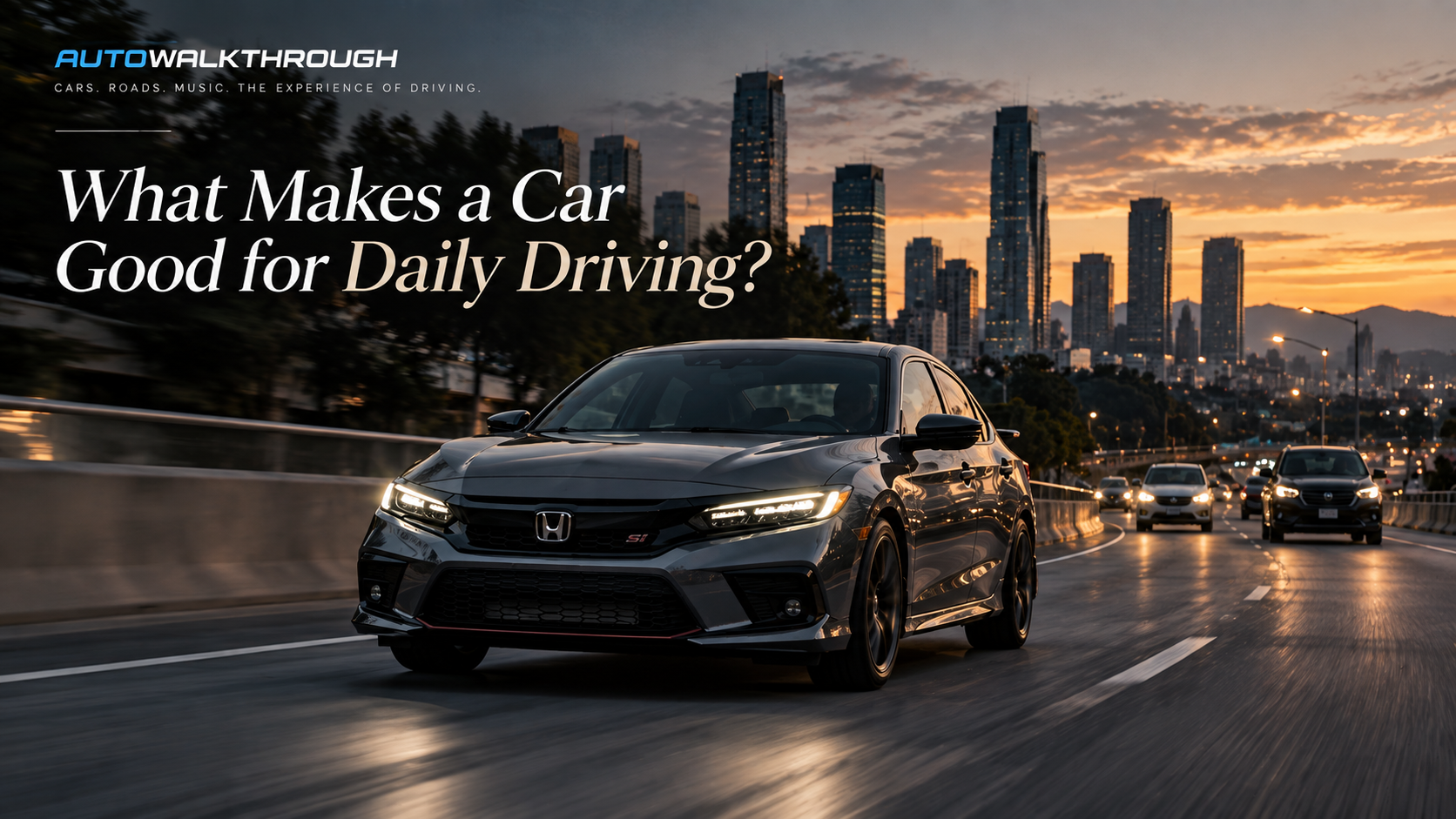
A car can be exciting for an hour and exhausting for an entire week.
That is one of the reasons choosing a good daily driver is different from choosing a performance car.
A weekend sports car might make every corner feel special. A luxury car might provide extraordinary comfort on the highway. An off-road vehicle might be perfect for adventure.
But a daily driver has a different job.
It has to work when you are tired.
It has to work when traffic is heavy.
It has to work when the weather is bad.
It has to work when you are carrying groceries, commuting to work or simply making a short trip across town.
That is why the best daily driving experience often comes from details that are easy to overlook.
A Good Daily Driver Should Make Everyday Life Easier
The most important characteristic of a daily car is not necessarily speed.
It is how little effort the car requires.
You get in, start the engine and everything feels familiar.
The controls make sense. The seats are comfortable. Visibility is good. The suspension handles imperfect roads without drama. Parking is easy. The climate control works without requiring a tutorial.
None of these things sound particularly exciting.
But when you use a car every day, they become extremely important.
1. Comfort Matters More Than You Expect
A daily driver can accumulate hundreds of hours of use every year.
That makes seating position, suspension and cabin comfort much more important than they might appear during a short test drive.
A seat that feels acceptable for twenty minutes may become uncomfortable after an hour.
A firm suspension that feels sporty on a smooth road can become tiring when the vehicle encounters potholes every morning.
Good daily-driver comfort is about balance.
The car should provide enough support without making every journey feel like a physical workout.
As we explored in 7 Things to Look for in a Car Seat for Long Drives, seating position and support can have a major effect on how a driver feels after several hours behind the wheel.
2. Visibility Reduces Driving Stress
Good visibility is one of the most underrated features in a car.
You need to understand where the vehicle begins and ends.
You need to see traffic around you.
You need to judge parking spaces.
You need to recognize pedestrians and cyclists.
A vehicle with excellent visibility can feel easier to drive even if it is physically larger than another car.
Modern driver-assistance systems can help, but they do not completely replace a clear view of the environment.
For daily driving, seeing the road clearly is a form of comfort.
3. The Steering Should Be Easy to Understand
Daily driving does not require extremely aggressive steering.
What matters is predictability.
The steering should respond naturally to small inputs.
It should not require constant correction on a straight road.
At low speeds, it should make parking and maneuvering easy.
At highway speeds, it should provide enough stability to keep the driver relaxed.
This is different from the highly communicative steering enthusiasts may want from a sports car.
A daily driver needs to make normal driving feel effortless.
4. Ride Quality Is a Daily Conversation
You experience the suspension every time you drive.
Speed bumps, broken pavement, expansion joints, uneven roads and rough parking lots all reveal how well a car handles its environment.
A good daily driver does not necessarily need extremely soft suspension.
It needs suspension that is well matched to the roads it is expected to use.
A car that absorbs imperfections without excessive body movement can feel comfortable and controlled at the same time.
This becomes particularly important when daily driving includes both city streets and highways.
5. The Engine Should Feel Predictable
Daily driving rarely requires maximum engine performance.
What matters more is how naturally the power arrives.
A smooth throttle response makes low-speed driving easier.
Enough torque makes merging into traffic less stressful.
A predictable engine makes the vehicle easier to operate in constantly changing conditions.
Huge horsepower figures are impressive, but they are not particularly useful if the vehicle feels difficult to control during ordinary driving.
A good daily driver makes its performance accessible rather than intimidating.
6. The Transmission Changes the Character of Everyday Driving
The transmission has a major influence on daily usability.
A good automatic transmission can make traffic almost effortless.
A well-designed manual transmission can make even routine journeys more engaging.
Continuously variable transmissions and dual-clutch systems provide different driving characteristics as well.
The important thing is how the transmission behaves in the situations you encounter most often.
Does it respond smoothly in traffic?
Does it select appropriate gears?
Does it hesitate when you need acceleration?
Does it feel natural with the engine?
These questions matter more to a daily driver than a headline acceleration number.
7. Cabin Noise Can Change Your Entire Day
Noise becomes much more noticeable when you spend hours inside a car every week.
Road noise, tire noise, wind noise and engine sound all contribute to the cabin environment.
A quiet cabin can make commuting less tiring.
It can also make conversations easier and allow music to sound better at lower volume.
This does not mean every daily driver needs to be completely silent.
Some people enjoy hearing the engine.
The important factor is whether the overall sound level suits the vehicle’s purpose.
8. Climate Control Should Be Simple
Climate control is one of those features that becomes invisible when it works properly.
You set the temperature and continue driving.
When the system requires constant adjustment, however, it becomes a distraction.
A good daily driver should maintain a comfortable cabin without demanding much attention from the driver.
This is especially important in regions with significant heat, humidity or changing weather.
Comfort is not only about the seats.
The entire cabin environment matters.
9. Technology Should Reduce Work
Modern cars can contain enormous amounts of technology.
Some of it is genuinely useful for everyday driving.
Navigation, parking cameras, blind-spot monitoring, adaptive cruise control and hands-free connectivity can reduce the amount of work required from the driver.
But technology can also become distracting when simple functions are buried inside complicated menus.
A good daily driver should make common tasks easy.
You should not need to navigate through several screens just to adjust something you use every day.
10. Phone Connectivity Has Become Part of Daily Driving
For many drivers, a smartphone is part of the driving environment.
Navigation, calls, music and other information can all be accessed through modern connectivity systems.
The important factor is integration.
A phone should be easy to use without becoming a source of distraction.
This is also why a properly positioned phone mount can be useful when a vehicle’s built-in system does not provide an ideal viewing position.
11. Fuel Economy Matters Because You Use the Car Often
A small difference in fuel consumption can become significant when a vehicle is driven every day.
That does not mean maximum fuel economy should always be the priority.
A car that saves fuel but creates an unpleasant driving experience may not feel like a good daily driver.
The goal is balance.
Reasonable efficiency combined with useful performance and acceptable comfort can make a vehicle easier to live with.
Hybrid and electric vehicles add different considerations, including charging access and driving range.
The right choice depends heavily on how the car is actually used.
12. Reliability Becomes More Important With Frequency
A car that is driven every day has more opportunities to reveal problems.
That makes reliability particularly important for daily use.
Routine maintenance, tire condition, brakes, fluids and battery health all contribute to dependability.
Reliability is not simply about avoiding major mechanical failures.
It is also about how predictable ownership feels.
Knowing that the car will start in the morning and perform its basic tasks without drama is valuable.
13. Practicality Should Match Your Life
There is no universal definition of a practical car.
For one driver, practicality might mean a large trunk.
For another, it might mean rear-seat space.
Someone living in a crowded city may value compact dimensions and easy parking.
A family may need doors that open wide and enough space for passengers.
A driver who regularly takes road trips may prioritize luggage capacity and long-distance comfort.
Practicality is therefore personal.
The right daily driver is the one that fits the life surrounding it.
14. Easy Parking Is a Bigger Advantage Than It Sounds
Parking is something you may do several times a day.
A vehicle that is easy to position can reduce frustration considerably.
Compact dimensions help, but cameras, sensors, steering visibility and a manageable turning radius also matter.
This is a good example of how a small feature can become important through repetition.
A difference that seems insignificant during a short test drive can become meaningful after months of daily use.
15. Tire and Wheel Choices Affect Daily Comfort
Wheels and tires influence much more than appearance.
A large wheel with a low-profile tire may create sharper steering response, but it can also transmit more road imperfections into the cabin.
A tire with a taller sidewall can provide additional cushioning over rough surfaces.
The best combination depends on the vehicle and the roads it regularly encounters.
This is another reason specifications alone do not completely describe driving comfort.
16. Highway Behavior Still Matters
Even a city-focused daily driver will probably spend time on faster roads.
Highway stability, cabin noise, seat support and steering behavior therefore remain important.
A vehicle that feels calm at cruising speed can make longer journeys much easier.
As we explored in What Makes a Car Comfortable on the Highway?, the highway reveals qualities that may not be obvious during short urban drives.
17. A Good Daily Driver Should Still Have Some Personality
Practicality does not mean a car has to be boring.
Some of the best daily drivers combine useful characteristics with a distinctive personality.
The engine might have an interesting sound.
The steering might feel particularly natural.
The interior might have a memorable design.
The vehicle might simply make you smile when you walk toward it in the parking lot.
Those details matter because you are going to spend a lot of time with the car.
A daily driver does not need to be a sports car.
It just needs to give you a reason to enjoy using it.
18. The Best Daily Driver Is Different for Everyone
Someone who drives five minutes to work has completely different requirements from someone who spends two hours commuting every day.
A family has different priorities from a single driver.
A city resident has different needs from someone living in a rural area.
A person who loves driving may accept compromises that another driver would never consider.
That is why universal lists of the “best” daily cars can only tell part of the story.
The more useful question is:
What does your daily driving actually require?
Daily Driving Is Where a Car Becomes Part of Your Life
A weekend car can be special because you choose when to drive it.
A daily driver is different.
You experience it on ordinary mornings, boring traffic, rainy afternoons, short errands and unexpected journeys.
It becomes part of your routine.
That makes small details surprisingly important.
The seat that supports you.
The steering that feels natural.
The suspension that absorbs a rough road.
The climate control that simply works.
The storage space you use every day.
The engine that responds exactly as expected.
These are the characteristics that define daily driving.
The Best Daily Driver Is the Car You Don’t Have to Fight
A good daily driver should not constantly demand your attention.
It should help you get through the day.
It should be comfortable when you are tired, predictable when traffic becomes complicated and practical when life gets busy.
But ideally, it should also have enough personality to make you appreciate getting behind the wheel.
That balance is what makes a car genuinely good for daily driving.
Not maximum horsepower.
Not the biggest wheels.
Not the longest list of technology.
Instead, it is the combination of comfort, usability, reliability, practicality and driving character that makes everyday journeys feel easier.
Because the most important car is not always the one that impresses you for ten minutes.
Sometimes it is the one that makes every ordinary drive feel just a little better.