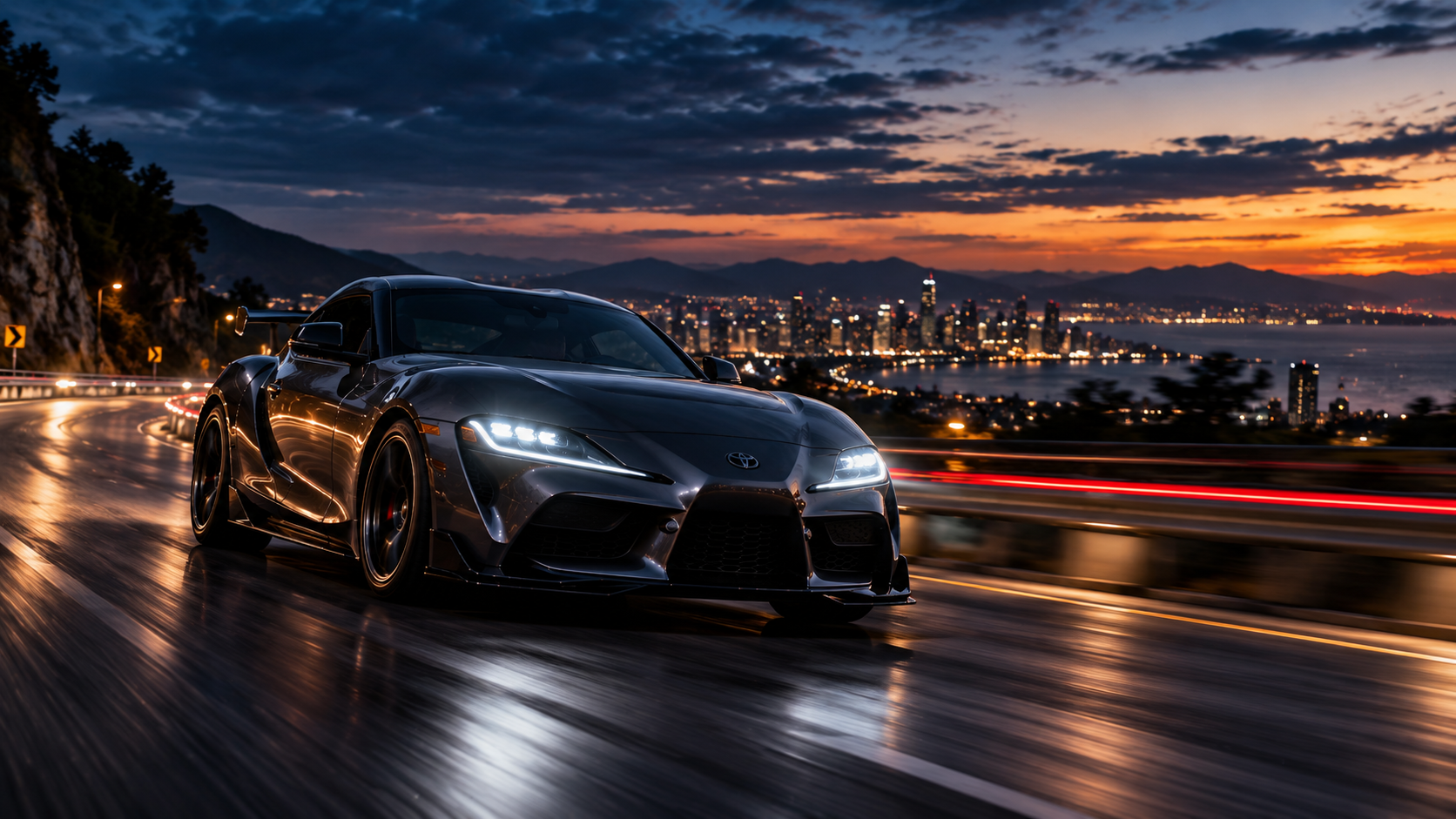
Some music sounds good in a living room.
Some music sounds better through headphones.
And some music seems almost designed for the road.
Progressive trance belongs to that last category.
There is something about a steady beat, gradual progression and wide atmospheric sound that fits naturally with the movement of a car.
The road keeps moving.
The lights keep passing.
The engine maintains its rhythm.
And the music continues building in the background.
When those elements come together, driving can feel completely different.
This does not mean progressive trance is the only music that works behind the wheel. Every driver has different tastes, and different roads can create different moods.
But progressive trance has several characteristics that make it particularly interesting for long drives, night drives and open roads.
Progressive Trance Is Built Around Movement
One of the defining characteristics of progressive trance is gradual development.
A track may begin with a simple rhythm and slowly introduce additional layers.
A melody appears.
A bassline develops.
Atmospheric sounds expand the space.
The track continues moving forward without necessarily demanding a dramatic change every few seconds.
That structure works surprisingly well with driving.
A road trip is also about progression.
You leave one place.
You pass through another.
The scenery changes.
The destination gets closer.
The journey continues.
There is a natural connection between the structure of the music and the structure of the drive.
1. A Steady Beat Can Match the Rhythm of the Road
Driving already has a rhythm.
Lane markings pass underneath the car.
Streetlights appear at regular intervals.
Traffic moves forward.
The engine maintains a certain speed.
Progressive trance adds another layer of rhythm to that environment.
A consistent beat can become part of the background movement without constantly demanding attention.
That can make a long highway journey feel more cohesive.
The road provides the visual rhythm.
The car provides the physical rhythm.
The music provides the soundtrack.
2. Repetition Does Not Always Mean Boredom
Progressive trance often uses repetition as part of its structure.
A beat may remain consistent while other elements gradually change around it.
For a listener expecting constant surprises, that may initially seem simple.
But while driving, repetition can actually work in its favor.
You are already concentrating on the road, traffic and surroundings.
Music that maintains a recognizable structure can create atmosphere without becoming unnecessarily distracting.
The experience becomes less about waiting for the next dramatic moment and more about allowing the entire track to develop.
3. The Gradual Build Fits Long-Distance Driving
A short drive and a six-hour road trip have completely different rhythms.
A short journey may need only a few songs.
A long journey has room for progression.
This is where progressive trance becomes especially interesting.
A track can slowly develop over several minutes, creating a sense of movement that mirrors the journey itself.
The beginning of the track can accompany the first few miles.
The middle can arrive when the landscape begins to change.
The final section can feel like another stage of the journey.
It creates a musical sense of distance.
That relationship between music and movement is one reason music can change the driving experience so dramatically.
4. Atmosphere Matters as Much as Rhythm
Progressive trance is not only about the beat.
Atmosphere is equally important.
Wide pads, layered melodies, subtle effects and spacious production can create the feeling of being surrounded by sound.
Inside a car, that atmosphere can become almost cinematic.
The windshield becomes a frame.
The road becomes the moving image.
City lights become part of the background.
The music fills the space between the driver and the outside world.
This is particularly effective after sunset.
5. Why Progressive Trance Fits Night Drives
Night driving changes the visual environment.
There are fewer details visible in the distance.
Headlights become more prominent.
Streetlights create repeating patterns.
Buildings become silhouettes.
Wet roads reflect light.
Traffic appears as lines of red and white moving through the darkness.
In that environment, progressive trance can add another layer to the experience.
The combination of electronic textures, steady rhythm and changing city lights can create a distinctly cinematic atmosphere.
It is one reason night drives have become such an important part of the AutoWalkthrough concept.
6. The Music Can Make Familiar Roads Feel Different
You do not need an exotic destination to have an interesting drive.
Sometimes the road you use every week can feel completely different with the right soundtrack.
The route has not changed.
The buildings are still there.
The traffic lights are still there.
But the atmosphere has changed.
This is one of the most interesting relationships between music and memory.
A particular track can become associated with a road, a city or a specific period of your life.
Eventually, hearing that track again can bring the entire journey back.
7. Progressive Trance Leaves Room for the Road
Driving requires attention.
You have to monitor traffic, road conditions, signs and other vehicles.
That means music should complement the experience rather than compete with it.
Progressive trance can work well in this environment because much of its structure is continuous.
There is often a consistent foundation underneath the changing layers.
The music can remain present without requiring the listener to constantly follow every individual event.
That makes it particularly suitable as background music for long stretches of road.
8. Tempo Can Influence the Feeling of Speed
Music does not actually change how fast the car is traveling.
But it can influence how the journey feels.
A slow atmospheric track can make a road feel relaxed.
A faster and more energetic track can make the same road feel more intense.
Progressive trance often sits in an interesting middle ground.
It can provide energy without necessarily feeling chaotic.
The result can be a sense of forward momentum that matches the visual movement outside the car.
9. Long Tracks Can Reduce Playlist Interruptions
One practical advantage of electronic music is that tracks can often be longer than conventional radio songs.
A longer track can maintain a particular atmosphere for an extended period.
There are fewer abrupt changes between completely different musical styles.
Instead of constantly resetting the mood, the journey can feel like one continuous sequence.
This is particularly useful on highways and long-distance road trips.
The objective is not necessarily to find the most exciting song every few minutes.
Sometimes consistency is exactly what makes the experience enjoyable.
10. Progressive Trance Creates a Cinematic Feeling
There is a reason electronic music is often associated with visual media.
Its layered production can create a strong sense of space and movement.
Inside a moving car, that quality can become especially noticeable.
A highway interchange appears ahead.
The city skyline slowly approaches.
A tunnel briefly removes the outside scenery.
The road opens again.
Then the track reaches another stage of its progression.
It can feel almost like a film without a fixed storyline.
The driver becomes both the audience and the person controlling the camera.
11. The Car Becomes Part of the Soundtrack
Music is only one part of the driving environment.
The car itself produces sound.
There is the engine.
The tires.
The wind.
The subtle mechanical sounds that remind you that you are inside a machine moving through space.
These sounds exist underneath the music.
In a quiet car, the music can become the dominant atmosphere.
In a performance car, the engine may become part of the soundtrack itself.
The relationship between the two can be surprisingly satisfying.
12. The Right Music Depends on the Road
There is no single perfect driving playlist.
A winding mountain road may call for something different from a straight interstate highway.
A busy city commute may require a different atmosphere from an empty coastal road.
Even the weather can change what feels appropriate.
Rain, fog, sunset and clear blue skies all create different visual environments.
That is why a good driving playlist should not simply be a collection of songs you like.
It can also be a collection of moods that match different kinds of journeys.
13. Progressive Trance Works Especially Well When You Are Not in a Hurry
One of the best ways to experience progressive music is to allow it time to develop.
The same philosophy applies to driving.
When there is no need to rush, the journey itself becomes part of the experience.
You notice the road.
You notice the scenery.
You notice the changes in light.
You begin to appreciate small details that would normally disappear when the only objective is reaching the destination.
This connects directly with the philosophy behind the art of the long drive.
14. Music Can Become Part of the Memory
Years later, you may not remember every street you drove on.
You may not remember the exact time you arrived.
You may not even remember every detail of the car.
But you may remember the song.
That is because music has an unusual relationship with memory.
A particular melody can instantly transport you back to a place and time.
Suddenly you remember the highway.
The weather.
The lights.
The person sitting beside you.
The feeling of being somewhere between two destinations.
The music becomes part of the story.
15. The Best Driving Music Does Not Need to Be Loud
There is a temptation to turn the volume up when driving.
But volume is not the same thing as atmosphere.
A well-produced progressive trance track can create a large sense of space without needing extreme volume.
The goal is to allow the music to sit naturally inside the cabin.
It becomes part of the environment rather than overwhelming it.
This can make longer listening sessions more comfortable as well.
Progressive Trance and the AutoWalkthrough Experience
For AutoWalkthrough, the connection between progressive trance and driving goes deeper than simply choosing background music.
Cars create movement.
Roads create direction.
Music creates atmosphere.
Photography and video capture the visual side of the experience.
When those elements come together, they create something that is difficult to describe through specifications alone.
A car can be discussed through horsepower, weight and acceleration.
A road can be described through distance and geography.
A song can be described through tempo and production.
But the experience created when all three exist together is something different.
That is the space where AutoWalkthrough lives.
The Road Is the Constant
The interesting thing about driving is that the environment is always changing.
The road bends.
The weather changes.
The city disappears behind you.
A new landscape appears.
Traffic becomes lighter.
The destination gets closer.
Progressive trance mirrors that feeling through gradual movement.
It does not need to rush toward the next moment.
It allows the current moment to develop.
That makes it particularly natural for driving.
The Perfect Driving Soundtrack Is Personal
Ultimately, the best music for driving is the music that fits the driver, the car and the road.
For one person, that might be progressive trance.
For another, it might be rock, jazz, ambient music or something completely different.
There is no universal answer.
What matters is the relationship between the music and the journey.
When the right track comes on at the right moment, an ordinary drive can suddenly feel memorable.
When Music, Cars and Roads Become One Experience
A great drive is rarely about only one thing.
It is the combination of the car beneath you, the road ahead, the environment around you and the soundtrack filling the cabin.
Progressive trance works particularly well because its rhythm, repetition, atmosphere and gradual progression naturally complement movement.
It gives long roads a sense of continuity.
It gives night drives an atmosphere.
And sometimes, it gives an ordinary journey a memory worth keeping.
That is why progressive trance can feel so natural behind the wheel.
Not because it was created specifically for every driver.
But because its sense of movement matches something that is already happening every time you drive.
The road is moving.
The music is moving.
And for a while, everything feels like one continuous journey.
Cars. Roads. Music.
The Experience of Driving.