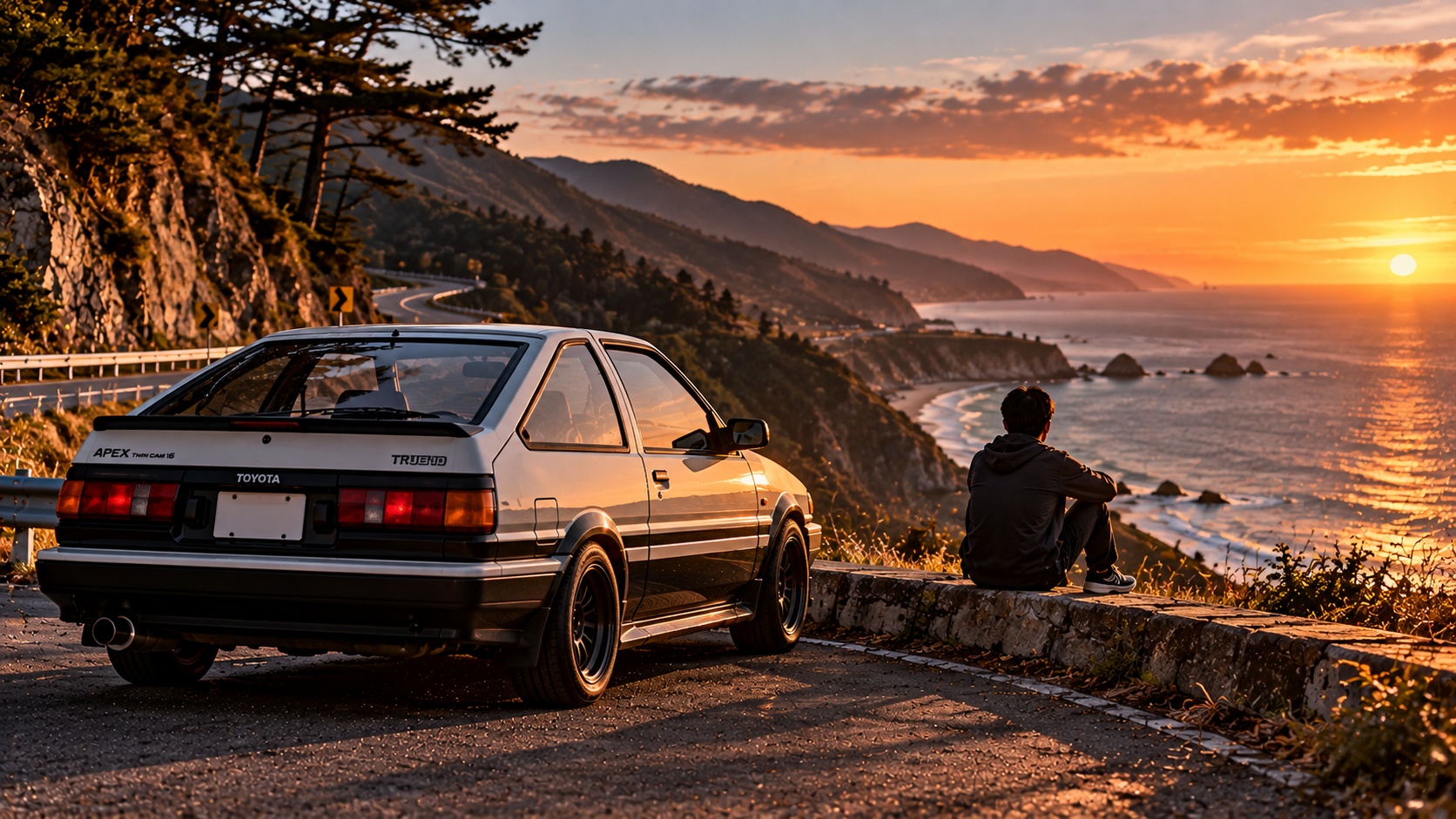
Why do some cars become more desirable decades after production ends, while others are quickly forgotten? The answer is rarely just speed, price, or rarity. A car can earn a lasting place in automotive history through its engineering, distinctive design, driving experience, and the community that keeps it alive.
The Toyota AE86 and Porsche 911 illustrate two very different paths to iconic status. The AE86 became closely associated with accessible rear-wheel-drive performance and grassroots motorsport, while the 911 built its reputation through a recognizable design and decades of engineering development. Their stories reveal what can turn an ordinary production car into a lasting automotive icon.
An automotive icon does not have to be the fastest car of its era, the most expensive, or even the most successful commercially. Some are celebrated for their engineering. Others become famous through films, motorsport, or popular culture. A few begin as relatively ordinary vehicles before enthusiasts discover qualities that make them special.
What connects them is their ability to leave a lasting impression. They become more than products sold by a manufacturer. They become reference points in automotive history.
Two Automotive Icons, Two Different Paths
The Toyota AE86 and the Porsche 911 show that there is no single formula for creating an automotive icon. One became closely associated with accessible rear-wheel-drive driving and grassroots motorsport culture. The other built its reputation through decades of sports-car engineering, distinctive design and continuous development.
Toyota AE86: The Appeal of Driver Involvement
Introduced in May 1983, the Toyota Corolla Levin and Sprinter Trueno AE86 used a 1.6-liter DOHC engine in a front-engine, rear-wheel-drive layout. The formula was relatively straightforward, but it gave enthusiasts a car that could be enjoyed, modified and developed according to their own driving preferences.
Its reputation grew beyond the original showroom audience. Enthusiasts embraced the AE86 for tuning and motorsport, while its connection with Japanese drifting culture and popular media introduced the car to new generations. Toyota itself has acknowledged the model’s lasting popularity and the continuation of its spirit in later 86 models.
The AE86 demonstrates how a car can become iconic without relying on luxury or extraordinary power. Its lasting appeal comes partly from the relationship between the driver and the machine: a relatively simple platform that rewards skill, experimentation and personal involvement.
Source: Toyota’s official history of the AE86 and its heritage parts project.
Porsche 911: Evolution Without Losing Its Identity
The Porsche 911 followed a different route. Porsche presented the original 901 prototype at the Frankfurt Motor Show in September 1963, and the model entered production in 1964 under the 911 name. Its recognizable silhouette, rear-mounted flat-six engine and sports-car proportions established a foundation that subsequent generations continued to develop.
The important point is not that every generation looks identical. The 911 has changed substantially in performance, safety, technology and everyday usability. Instead, Porsche has repeatedly refined the car while preserving visual and engineering characteristics that connect newer versions with the original.
This continuity gives the 911 a clear identity across generations. A modern version can be considerably more capable than an early car, yet the relationship between the two remains recognizable. The model’s history becomes part of the product itself, giving buyers and enthusiasts a connection that goes beyond a list of specifications.
Source: Porsche’s official history of the first-generation 911.
What These Two Cars Have in Common
The AE86 and the 911 occupy very different positions in the automotive world, but both have maintained a recognizable identity. The Toyota’s appeal is strongly connected to driver involvement, modification and enthusiast culture. The Porsche’s appeal is tied to its distinctive design, engineering development and continuity across generations.
These examples reveal an important distinction: an iconic car does not have to be the best at every measurable task. It needs a character that people can recognize, explain and care about. That character may come from the way a car drives, the way it looks, the community surrounding it or the way its original idea survives through changing times.
Distinctive Design Makes a Car Memorable
One of the clearest characteristics of an automotive icon is a design that people can recognize years later.
It might be a particular roofline, an unusual headlight arrangement, a long bonnet, or a compact body with proportions that feel perfectly balanced. Sometimes, the design is dramatic. In other cases, its appeal comes from simplicity.
The most memorable designs often have a strong identity without relying entirely on decoration. Their proportions make sense, their details work together, and the overall shape remains recognizable even when the vehicle is seen from a distance.
Design also captures the priorities of a particular era. Boxy bodywork may remind people of a period when practical packaging and clear geometric forms were fashionable. Low, aerodynamic sports cars can reflect changing expectations about performance and efficiency.
As automotive styling evolves, older designs may begin to look unusual. That difference can strengthen their appeal, especially when modern cars share increasingly similar proportions or visual features.
However, distinctive styling alone does not guarantee iconic status. Many unusual cars disappear from memory. Design becomes more powerful when it is connected to a wider story about engineering, culture, or the experience of owning and driving the vehicle.
Engineering Gives an Icon More Than a Famous Shape
A car can attract attention through its appearance, but its engineering often determines whether enthusiasts continue discussing it long after production ends.
Some vehicles become famous because they introduced important technology or demonstrated what a manufacturer could achieve. Others combine familiar components in a way that creates an unusually rewarding driving experience.
Engine character, chassis balance, weight, steering response, and the relationship between the driver and the controls can all contribute to a vehicle’s reputation. A car does not need extraordinary power to be memorable if its components work together exceptionally well.
In fact, a modest car can become an enthusiast favorite precisely because its performance is accessible. The driver can explore its handling and response without needing a racetrack or extremely high speeds to appreciate what makes it different.
Engineering can also create an identity that competitors struggle to reproduce. When a particular vehicle delivers a recognizable combination of performance, practicality, and character, it can establish a reputation that survives changes in the market.
That is one reason certain cars remain desirable even when newer vehicles offer more power, better technology, and improved efficiency. Their significance is not limited to being the best by modern measurements.
They offer an experience that people continue to value.
The Right Car Can Arrive at the Right Moment
Timing plays a significant role in automotive history.
A car introduced during a period of changing tastes, economic conditions, or technological development may capture public attention in a way that a similar vehicle introduced later does not.
An affordable sports car can arrive when younger drivers are looking for attainable performance. A practical hatchback can become important when urban mobility and fuel economy are high priorities. A new type of vehicle can attract attention when buyers begin reconsidering what they need from transportation.
Market conditions also influence how widely a car spreads. Pricing, availability, dealer support, and maintenance costs affect whether people can realistically own one. A brilliant machine that few buyers can access may have a different cultural influence from a relatively affordable car sold in large numbers.
None of these factors guarantees lasting recognition. Many vehicles arrive at promising moments and are eventually forgotten. But when timing aligns with strong design, engineering, and public interest, a car can become associated with an important turning point.
Years later, enthusiasts may remember the vehicle not simply as a model from a particular year, but as a symbol of what was changing in the automotive world.
Motorsport Can Build a Car’s Reputation
Competition has helped establish the reputations of many memorable vehicles.
Racing and rallying place engineering decisions under demanding conditions. Performance, durability, handling, and development become visible through results, while drivers and teams provide stories that fans can follow.
When a road car shares recognizable characteristics with a successful competition vehicle, some of that excitement can transfer to the production model. Even when the road version is mechanically different, the association may give it an identity that ordinary advertising cannot easily create.
Motorsport also helps preserve a car’s history. Memorable races, rivalries, championship campaigns, and engineering breakthroughs become part of the stories told about a model.
However, competition success is not essential for every icon. Some vehicles earn their reputations through design, affordability, reliability, or cultural influence. Others become famous because they are enjoyable to own rather than because they were built to win races.
Motorsport is one route to recognition, not the only route.
Movies, Games, and Music Can Change a Car’s Legacy
Automotive icons do not exist only on roads and racetracks. Entertainment can introduce vehicles to audiences who might never encounter them in real life.
A memorable appearance in a film can make a particular model recognizable around the world. Video games can give players the opportunity to drive cars they have only seen in photographs. Music videos, magazines, and online communities can connect a vehicle to a lifestyle or a particular era.
These associations sometimes become more influential than the original marketing campaign. A car may gain new admirers decades after it was introduced because a younger audience discovers it through digital media.
This can create an interesting cycle. The vehicle appears in entertainment, interest grows, enthusiasts begin researching it, and owners share photographs, technical information, and restoration projects. The growing community then gives the car another reason to remain visible.
Popular culture can also simplify a car’s reputation. A vehicle known primarily for a fictional character or a dramatic scene may become famous even among people who know little about its actual engineering.
That does not make its cultural importance less real. It simply means that an automotive icon can have several identities: the car as engineered, the car as driven, and the car as imagined by the public.
Enthusiast Communities Keep Icons Alive
A car’s story does not end when the factory stops building it.
Owners, mechanics, restorers, collectors, and independent specialists help preserve vehicles long after their original production runs have ended. They maintain technical knowledge, locate replacement parts, document factory specifications, and find ways to keep aging machines usable.
Enthusiast communities make that process more visible. A local meet can introduce a forgotten model to people who have never seen one before. An online discussion can help an owner solve a difficult mechanical problem. A restoration project can reveal details that would otherwise be lost.
These activities help turn a car from an old product into a continuing cultural object.
They also explain why the same model can mean different things to different generations. An older owner may remember buying it new, while a younger enthusiast may know it from restoration videos or racing games.
Both groups contribute to its ongoing story.
As we explored in Why Car Meets Are About More Than the Cars, gatherings are often as much about shared knowledge, friendships, and personal histories as they are about the vehicles themselves.
Why Some Ordinary Cars Become Cult Favorites
Not every icon begins as an expensive or exclusive machine.
Some start as everyday cars that gradually attract attention because of their balance, reliability, affordability, or suitability for modification. Their popularity grows as owners discover what they can do with them.
A lightweight hatchback might become a favorite among driving enthusiasts. A compact coupe may develop a strong following because its layout responds well to careful tuning. A family sedan might become respected for its durability and the ease with which specialists can maintain it.
Over time, these qualities can produce a loyal community that extends far beyond the original buyer base.
Part of the appeal is accessibility. Enthusiasts can learn mechanical skills, exchange parts, and personalize a vehicle without needing the budget required for an exotic sports car.
That accessibility does not mean every modification improves the car. Poorly executed changes can reduce reliability, compromise handling, or create safety problems. The most respected builds often reflect an understanding of the original engineering rather than a desire to change everything.
Sometimes, the ordinary car becomes special because people discover what it can do when it is maintained, driven, and understood properly.
Scarcity Can Increase Interest, but It Is Not Enough
Rarity can influence a car’s reputation. Limited production numbers, motorsport history, unusual specifications, and surviving condition can all make a model attractive to collectors.
As more examples disappear through accidents, corrosion, neglect, or modification, original vehicles may become harder to find. Enthusiasts who value originality may place particular importance on cars that retain their factory components and appearance.
But scarcity by itself does not make a vehicle culturally important. Plenty of rare cars remain relatively unknown, while mass-produced models become widely admired.
A car generally needs a reason to matter beyond the difficulty of finding one. It may have exceptional design, a distinctive driving experience, an important place in automotive history, or strong emotional associations.
Scarcity can amplify those qualities, but it rarely substitutes for them.
This is also why market value should not be confused with personal significance. An inexpensive car can be meaningful to its owner, while a highly collectible model may remain an object of admiration rather than a source of personal connection.
Can a Modern Car Become an Icon?
Modern vehicles face a different environment from the cars that shaped earlier generations.
Technology changes quickly, new models arrive frequently, and software can influence the ownership experience as much as mechanical hardware. Electrification is also changing how vehicles are designed, packaged, and driven.
In this environment, a future icon may be remembered for introducing an important technology, making electric mobility more accessible, or establishing a design language that influences later vehicles.
Another may stand out by offering an unusually engaging driving experience in a market increasingly focused on comfort, efficiency, and digital features.
Modern cars also face practical challenges in achieving long-term recognition. Complex electronics can become difficult to maintain as vehicles age, and changes in software support may influence how well certain features continue to work. Long-term parts availability and repairability can affect which models remain usable decades later.
It is too early to know which current vehicles will become the most significant icons of their era. Some may gain recognition gradually as their importance becomes clearer. Others may be remembered primarily for the technologies or design trends they represented.
Time will help distinguish temporary popularity from lasting influence.
Why We Become Attached to Iconic Cars
There is a personal side to automotive icons that goes beyond their reputation among enthusiasts.
A particular car might remind someone of childhood, a first driving experience, or a period when they discovered an interest in engineering. It may represent independence, friendship, or the satisfaction of restoring something with their own hands.
That connection can be powerful even if the person has never owned the vehicle. Sometimes, seeing a familiar shape is enough to recall a film, a video game, or a childhood dream.
For owners, the relationship can become more intimate. The car’s sounds, controls, and imperfections become familiar through repeated use. The vehicle is no longer just an icon in a magazine; it is a machine with which the owner has built a personal history.
This is why some people continue to love older cars even when modern alternatives offer obvious practical advantages.
In Why We Get Attached to Cars That Aren’t Perfect, we explored how character, familiarity, and shared experiences can make an imperfect vehicle difficult to replace.
An icon’s public reputation may attract people to it, but personal experience is often what makes the relationship last.
What Really Makes a Car an Icon?
There is no single formula for creating an automotive icon.
Distinctive design helps a car stand out. Engineering gives it substance. Timing can place it at the center of a changing market, while motorsport and popular culture can introduce it to new audiences. Enthusiast communities then preserve its history and keep the conversation going.
Some cars combine all these qualities. Others become icons through only one or two, developing a reputation that grows in unexpected ways.
What matters is the lasting connection between the vehicle and the people who encounter it. A car becomes culturally significant when it continues to mean something after its original purpose as a new product has passed.
It might inspire a generation of designers, become a favorite among drivers, represent a turning point in technology, or simply remind thousands of people of a time they remember fondly.
Not every iconic car needs to be perfect. In fact, its distinctive qualities may be precisely what make it memorable.
The Cars We Remember Tell Stories About Us
Look at the cars people continue to restore, photograph, discuss, and search for years after production ends. Their appeal reveals more than a list of technical achievements.
It shows what people value in design, what kinds of driving experiences they enjoy, and which memories they want to preserve. It reflects the influence of entertainment, competition, communities, and the everyday moments that connect people to machines.
Some icons represent speed. Others represent practicality, ingenuity, or freedom. A few become symbols of an entire generation, even among people who have never driven one.
Their lasting importance is not measured only by horsepower, rarity, or price. It is measured by how often people return to their stories and how much those stories continue to inspire.
At AutoWalkthrough, we believe cars are more than products of their time. They are part of the culture, memories, and experiences built around driving.
And perhaps that is the clearest sign of an automotive icon: long after the original car has become a piece of history, people still have a reason to care about it.
How to Recognize a Future Automotive Icon
When evaluating whether a car could become an automotive icon, look beyond its current popularity or market price. Consider these five factors:
- Distinctive identity: Does the car have a recognizable design, engineering feature, or driving character?
- Historical significance: Did it introduce an important idea or represent a turning point for its manufacturer?
- Driving experience: Does it offer something memorable that drivers cannot easily find in other cars?
- Enthusiast support: Is there an active community preserving, restoring, modifying, or documenting the model?
- Long-term influence: Can you see its impact on later vehicles, automotive culture, or the expectations of drivers?
No single factor guarantees legendary status. A rare car may attract collectors without influencing automotive culture, while an affordable model can become widely admired because of its character and community.
The strongest candidates combine several of these qualities. Their significance becomes clearer over time as owners preserve them, enthusiasts share their stories, and later generations discover what makes them special.