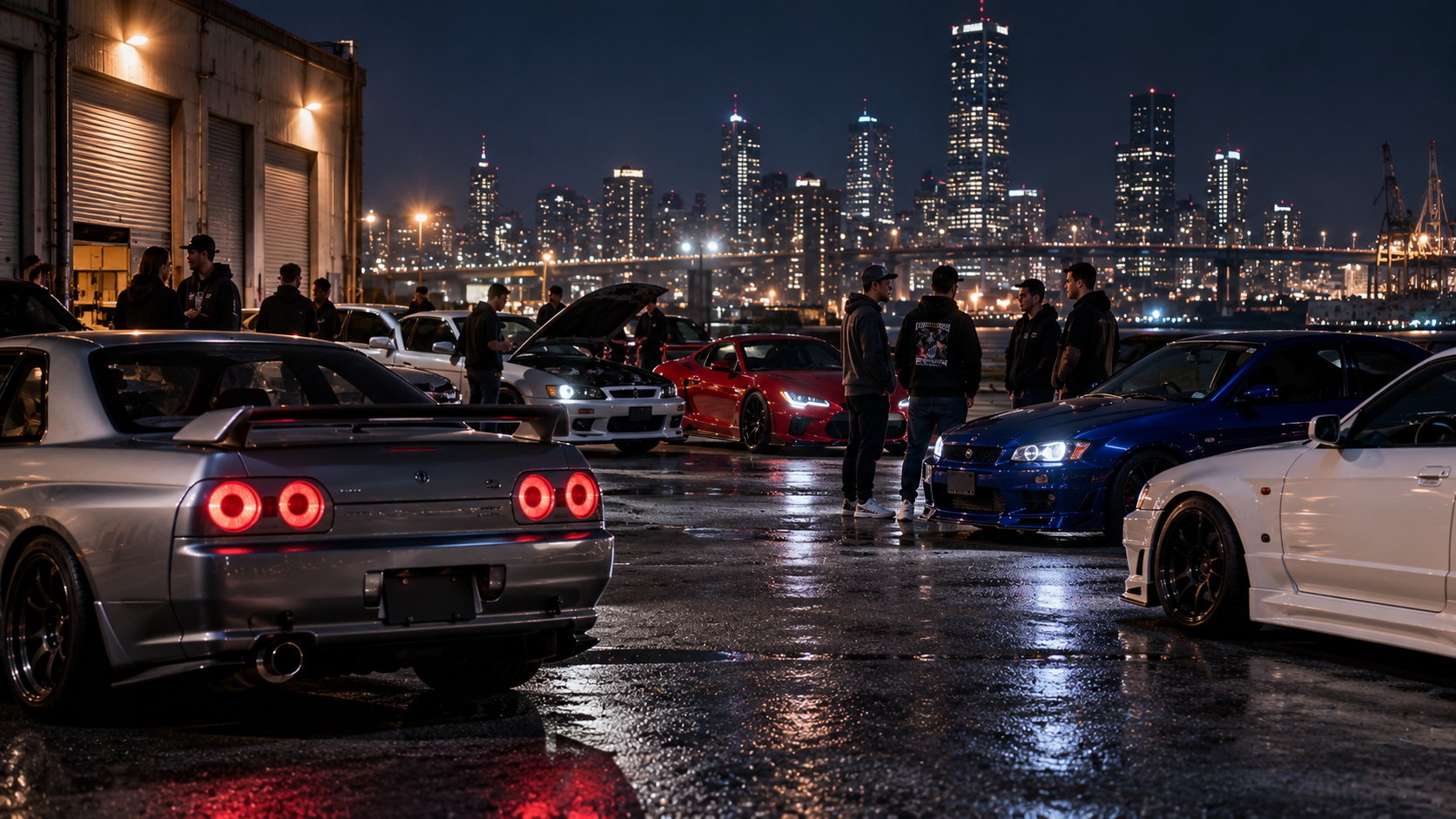
A car meet can look simple from the outside.
A parking lot fills with cars. People walk between them. Cameras come out. Conversations start around engines, wheels, modifications and memories.
But spend enough time around a good car meet and something becomes obvious: the cars are only part of the experience.
The real attraction is the community surrounding them.
People come to see interesting cars, but they also come to meet people who understand why a particular car matters. They come to exchange stories, discover something new and spend time around others who share the same fascination with automobiles.
That is why car meets remain an important part of automotive culture.
How to Make the Most of a Car Meet
A car meet becomes more rewarding when visitors treat it as a shared community space rather than simply a place to take photographs.
Look beyond the most expensive cars. A carefully maintained daily driver, a home-built project, or a rare factory-original vehicle can each tell an interesting story. The work and decisions behind a car are often more revealing than its price.
Ask before taking close-up photographs. General event photography may be welcome, but owners may prefer permission before someone photographs personal details, an unfinished project, or the interior of a vehicle.
Start conversations with genuine questions. Asking why an owner chose a particular modification, how long a restoration took, or what the car is like to drive can lead to a more meaningful exchange than commenting only on horsepower.
Respect the venue and other visitors. Avoid touching vehicles without permission, blocking access, or performing burnouts and loud acceleration in public areas. Responsible behavior helps events remain welcoming and protects their future.
Support the community after the event. Share photographs respectfully, credit photographers when appropriate, and follow local clubs or organizers to learn about future gatherings.
The best car meets are not necessarily the largest or most exclusive. They are the ones where people leave with new knowledge, useful connections, and a stronger appreciation for the vehicles and people around them.
The Car Is Often Just the Conversation Starter
A modified car parked at a meet can attract attention immediately.
Someone might ask about the wheels. Another person might notice the suspension setup. Someone else may recognize the engine swap.
Suddenly, two strangers have something to talk about.
That is one of the simplest powers of automotive culture.
A car creates common ground.
The conversation may begin with a vehicle, but it can quickly move toward road trips, old memories, motorsport, music, photography, mechanical work or completely unrelated subjects.
The automobile becomes the reason people meet.
1. Every Car Has a Story
The most interesting cars at a meet are not necessarily the most expensive.
Sometimes the car that attracts the most conversation is an ordinary vehicle with an unusual history.
Maybe someone bought it when they were young.
Maybe it belonged to a family member.
Maybe the owner spent years restoring it.
Maybe the car was almost scrapped before someone decided to save it.
These stories give cars meaning.
Two identical models can look exactly the same from across a parking lot, yet have completely different significance to their owners.
That personal history is one reason older cars continue to have such a strong place in automotive culture.
As we explored in Why People Still Love Older Cars, nostalgia and personal memories can become just as important as mechanical specifications.
2. Car Meets Create a Sense of Belonging
Enthusiasts do not always have many opportunities to discuss their interests in everyday life.
You can talk about work, family, travel and normal daily responsibilities almost anywhere.
But finding someone who genuinely wants to discuss the differences between generations of a particular car can be more difficult.
A car meet changes that.
For a few hours, the unusual becomes normal.
People who might normally feel like strangers suddenly have something in common.
That sense of belonging is an important part of any enthusiast community.
3. Knowledge Gets Passed From One Owner to Another
Car culture is also a form of informal education.
Someone might arrive with a problem they cannot solve.
Another enthusiast may have already experienced exactly the same issue.
A conversation about a strange noise can turn into a discussion about suspension components. A question about wheels can lead to a lesson about tire sidewalls. A discussion about an engine can become a conversation about maintenance, reliability or tuning.
This knowledge-sharing happens naturally.
There may be no classroom, no presentation and no formal teacher.
People simply learn from one another.
4. Modifications Become a Form of Personal Expression
Cars are increasingly complex machines, but enthusiasts still find ways to make them personal.
Wheels, suspension, exhaust systems, paint, interior details and countless smaller modifications can change the personality of a vehicle.
Not every modification is about performance.
Sometimes the goal is simply to create something that looks or feels right to its owner.
That makes a modified car similar to other forms of personal expression.
The vehicle becomes a reflection of someone’s taste.
One owner may prefer a clean and understated build. Another may want aggressive styling. Someone else may prioritize originality and restoration.
There is no single definition of what an enthusiast car should look like.
5. Different Generations Meet in the Same Parking Lot
One of the most interesting things about automotive culture is the way it connects different generations.
A younger enthusiast might arrive in a modern performance car.
Across the parking lot, someone may have brought a car from the 1980s or 1990s.
The technology may be completely different, but the conversation can still happen.
The younger enthusiast may ask how the older car drives.
The older owner may become curious about the newer car’s technology.
Cars create an unusual bridge between generations because every era has its own interpretation of what makes driving interesting.
6. The Internet Changed Car Culture, But It Did Not Replace Real Meetings
Modern car culture exists online as much as it exists in physical spaces.
Forums, social media groups, YouTube channels and automotive websites allow enthusiasts from different countries to communicate every day.
Someone can watch a walkaround of a rare car thousands of miles away.
They can learn how another owner solved a mechanical problem.
They can discover a new wheel design or see how a restoration project developed over several years.
But digital communities have one limitation.
You cannot completely reproduce the experience of standing beside a car, hearing its engine start and talking to the person who built or owns it.
The internet expanded automotive culture.
It did not eliminate the need for physical communities.
7. Photography Became Part of the Culture
Car meets also created a natural environment for automotive photography.
Some photographers are interested in documenting cars exactly as they appear.
Others treat the car as part of a larger visual story.
The location matters. So does the light, weather, road and atmosphere.
A car parked under fluorescent lights creates a completely different image from the same car photographed on an empty road at sunset.
This connection between cars and visual storytelling has become an important part of modern automotive media.
A vehicle is no longer simply photographed as an object.
It becomes part of a scene.
8. Music and Cars Naturally Belong Together
Cars and music have always had a close relationship.
A road trip without music can feel strangely incomplete.
A night drive can take on an entirely different atmosphere when the right track is playing.
Car meets often reflect this relationship through playlists, live DJs, event sound systems and videos built around music.
For some enthusiasts, music is almost another modification to the driving experience.
The right song can change the mood of an entire journey.
We explored this relationship in Progressive Trance and the Driving Experience, where music becomes part of the rhythm of the road rather than simply background sound.
9. Not Every Enthusiast Wants the Same Thing
Automotive culture is not one single community.
It contains many smaller communities.
There are people interested in classic cars, JDM cars, European cars, American muscle, off-road vehicles, electric vehicles, motorcycles, restoration projects, performance builds and completely original cars.
Some people care deeply about lap times.
Others care about appearance.
Some want maximum performance.
Others simply want to preserve an old car exactly as it was.
The diversity is part of what makes automotive culture interesting.
10. The Best Meets Feel Like a Shared Experience
A great car meet does not necessarily need hundreds of cars.
Sometimes a small gathering can be more memorable than a massive event.
A group of friends arriving together. Someone bringing a project car that has finally been completed. An unexpected conversation with another enthusiast. A drive afterward through the city.
Those moments become memories.
The cars provide the setting, but the people create the experience.
Why Some Cars Become Community Icons
Certain cars seem to have an unusual ability to bring people together.
They might be rare.
They might be affordable.
They might have a distinctive design.
Or they might simply represent an important period in automotive history.
When enough people become emotionally attached to a particular model, the car develops a culture of its own.
Owners share technical information. Enthusiasts create events. Parts become easier to find. Photographers document the cars. Stories accumulate.
The vehicle becomes more than a product.
It becomes a reference point for a community.
The Memories Are Often More Important Than the Cars
Ask someone about their favorite car and they may describe the vehicle in detail.
But ask them why it matters and the answer often involves a memory.
A first road trip.
A weekend spent working on a project car.
A late-night drive with friends.
A father teaching a child how to drive.
A car that survived for decades.
These experiences explain why automotive culture can become so emotional.
The machine is tangible, but the memories attached to it are personal.
Car Culture Is Really About People
It is easy to look at automotive culture and focus entirely on the vehicles.
The cars are the most visible part.
But behind every car is a person with a reason for owning it.
That reason might be performance, design, nostalgia, engineering, practicality or simply the feeling of driving it.
That human element is what turns a collection of cars into a community.
And it is why a car meet can remain memorable long after the cars have left the parking lot.
The Road Continues After the Meet
Often, the best part of a car meet happens afterward.
A group leaves together.
The parking lot becomes an empty road.
Engines start. Music comes on. Headlights stretch into the distance.
The gathering becomes a drive.
That transition from standing around cars to actually driving them captures something fundamental about automotive culture.
Cars are meant to move.
The community gives them meaning, but the road gives them purpose.
That is ultimately why car meets are about more than the cars.
They are about the people, the stories, the friendships, the memories and the shared experience of being fascinated by the automobile.
The cars bring everyone together.
The culture gives them a reason to stay.