Some songs feel made for headphones.
Others feel made for a crowded room.
And then there is music that seems to belong on the road.
Electronic music has a particularly strong relationship with driving. Its steady rhythms, repeating patterns, gradual progression and atmospheric soundscapes can fit naturally into the experience of moving through a landscape.
Put the right track inside a moving car and something interesting happens.
The music does not simply become background sound.
It can become part of the journey.
This is one reason progressive trance works so well for driving, particularly when the road is open, the traffic is light and there is enough time to settle into the journey.
Why Electronic Music Works So Well With Movement
Driving is a continuous activity.
The car moves forward.
The scenery changes.
Road markings pass underneath the windshield.
Buildings become trees. Trees become mountains. Mountains become open highways.
Unlike many everyday activities, driving naturally creates a sense of movement through space.
Electronic music often creates a similar sensation through sound.
A bassline repeats.
A melody slowly evolves.
Percussion builds.
New layers appear.
Then the track changes without completely abandoning what came before it.
That sense of continuous progression can feel surprisingly compatible with a long drive.
1. Repetition Creates a Sense of Continuity
One of the defining characteristics of electronic music is repetition.
A beat can continue for several minutes without needing to change dramatically.
At first, repetition might sound simple.
But during a drive, it can become something else.
The repeating rhythm provides a consistent sonic reference while everything outside the car continues to change.
The road curves.
The scenery changes.
The weather changes.
The light begins to disappear.
But the rhythm remains.
This contrast between a stable musical pattern and a constantly changing environment can make a drive feel more immersive.
Instead of constantly demanding attention with dramatic changes, the music creates a foundation that the journey can move across.
2. A Steady Beat Matches the Rhythm of the Road
There is a natural rhythm to driving.
You accelerate.
You maintain speed.
You slow down.
You turn.
You accelerate again.
Even when the driving itself is completely ordinary, there is a repeated sequence of movement.
A steady electronic beat can sit comfortably underneath that rhythm.
This does not mean the driver should attempt to match driving behavior to the tempo of a song. Safe driving should always remain the priority.
The interesting part is simply how compatible a consistent musical pulse can feel with continuous movement.
It gives the journey a subtle sense of structure.
3. Electronic Music Leaves Room for the Road
Another reason electronic music can work well while driving is space.
Many electronic tracks are built around atmosphere rather than constant lyrical storytelling.
There can be long instrumental sections, evolving textures and subtle transitions between musical ideas.
That leaves room for the environment to remain part of the experience.
You can still hear the engine.
You can still notice the tires moving across the pavement.
You can still see the changing landscape through the windshield.
The music becomes another layer rather than completely replacing everything around you.
This is particularly effective when driving through an open landscape.
A wide highway, distant mountains and an evolving electronic soundtrack can create an almost cinematic atmosphere.
4. Long Tracks Fit Long Journeys
Short songs are excellent for many situations.
But long drives can benefit from music that does not constantly reset itself.
A track that gradually develops over five or six minutes can feel different from a playlist filled with songs that change every two minutes.
The longer structure allows the listener to settle into the sound.
Instead of asking, “What is the next song?” the focus can remain on the road.
This is one reason extended electronic music can be particularly effective for highway driving and road trips.
The music has enough time to establish an atmosphere.
5. Progressive Music Mirrors the Journey
A good journey rarely feels completely static.
Even when you are driving along the same highway, the environment is constantly evolving.
The sun moves lower.
The sky changes color.
Traffic becomes lighter.
The city disappears behind you.
A progressive electronic track can create a similar feeling.
The beat may remain familiar while the arrangement gradually develops.
A new synth appears.
A melody becomes more prominent.
The bass changes.
The atmosphere becomes wider.
Then the track reaches a new section.
It is not necessarily about a huge musical climax.
It is about movement.
The music keeps going somewhere.
That quality can make it particularly suitable for a road that is also taking you somewhere.
6. Open Roads Create Space for Atmosphere
Electronic music can feel very different depending on where you listen to it.
The same track that sounds ordinary inside a bedroom can feel completely different when heard through a car’s speakers while traveling through an open landscape.
Context matters.
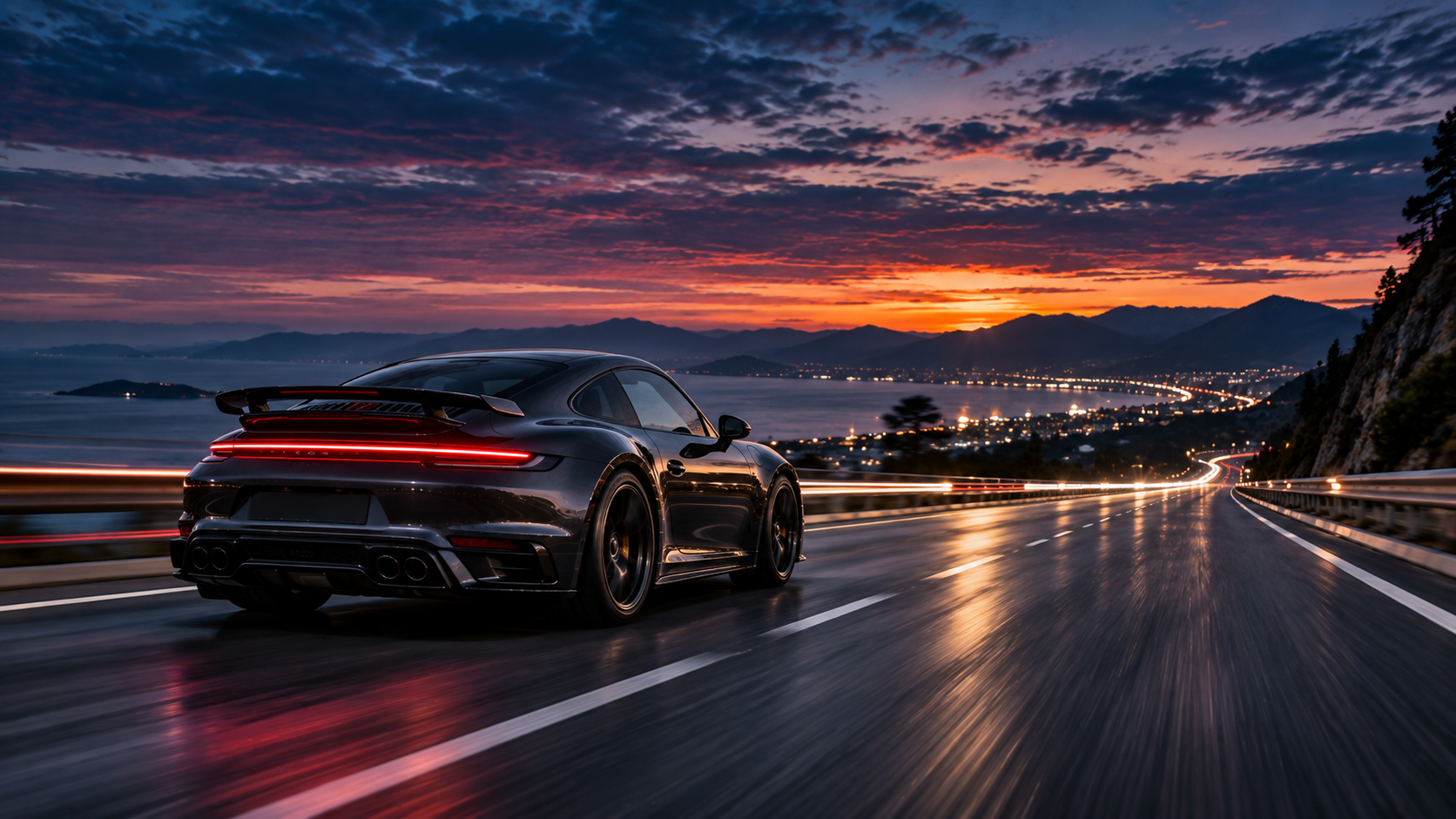
Imagine driving on a nearly empty highway shortly before sunset.
The sky is changing.
The road stretches toward the horizon.
The car is moving at a steady pace.
Then an atmospheric electronic track begins to build.
Suddenly the music and environment seem connected.
The landscape becomes part of the visual composition.
The road becomes the motion.
The music becomes the soundtrack.
That combination is one of the central ideas behind AutoWalkthrough.
7. Night Driving Makes the Effect Even Stronger
At night, the relationship between music and driving can become even more noticeable.
During the day, there is a huge amount of visual information.
Buildings, signs, trees, traffic and landscapes compete for attention.
At night, much of that visual information disappears.
Instead, you see headlights, streetlights, reflections, illuminated buildings and the road ahead.
For many drivers, this creates a more focused atmosphere.
Electronic music can complement that environment particularly well.
A deep bassline, atmospheric pads and gradual progression can turn an ordinary road into something that feels almost cinematic.
This is part of what makes night drives such a distinctive automotive experience.
8. Music Can Change the Perception of Distance
A long highway can sometimes feel repetitive.
There may be very little visual change for dozens of miles.
Music can give the journey a sense of progression.
Instead of thinking about the distance remaining, you may naturally become aware of sections of the journey through the music.
One track becomes associated with the first part of the drive.
Another track becomes associated with a sunset.
A particular melody becomes connected to a mountain road or a city skyline.
Eventually the soundtrack becomes part of your memory of the journey.
This is one reason music can change the driving experience so significantly.
9. The Best Driving Music Does Not Always Demand Attention
There is an important difference between music that sounds exciting and music that works well while driving.
A great driving track should create atmosphere without becoming a distraction.
Music with extreme changes, overwhelming vocals or constantly shifting dynamics may not always fit every driving situation.
For long-distance driving, many people prefer something more consistent.
A stable rhythm.
A controlled bassline.
A gradual arrangement.
Enough variation to remain interesting, but enough consistency to preserve the atmosphere.
This is where genres such as progressive electronic music can become particularly interesting.
10. The Car Becomes Part of the Sound
There is another element that should not be ignored.
The car itself contributes to the experience.
Engine noise.
Road noise.
Tire sound.
Wind.
The subtle vibration of the road.
All of these sounds exist alongside the music.
A quiet luxury sedan can create a completely different environment from a lightweight sports car with a louder exhaust.
The same electronic track can therefore feel different depending on the car.
This is why the relationship between cars and music is more interesting than simply creating a playlist.
The vehicle, the road, the sound system, the weather and the music all become part of the same experience.
Building an Electronic Driving Playlist
There is no universal perfect driving playlist.
The right selection depends on the journey.
For a short city drive, you might prefer tracks that establish an atmosphere quickly.
For a long highway journey, longer progressive tracks can work better.
For night driving, darker and more atmospheric sounds may complement the environment.
For a scenic road, melodic electronic music can provide a more expansive feeling.
The important thing is not simply choosing songs that you like.
Think about how the music interacts with the journey.
Does the track give the drive enough space?
Does it develop gradually?
Does it create an atmosphere without becoming distracting?
Does it fit the time of day?
Does it fit the road?
Those questions can transform a random playlist into a soundtrack for the journey.
When Music and Motion Become One Experience
The most memorable drives are rarely about one thing.
It is not only the car.
It is not only the road.
It is not only the music.
It is the combination.
A great car on an empty road feels different from the same car sitting in traffic.
The same road feels different during sunrise, sunset or midnight.
And the same journey can feel completely different depending on the soundtrack.
That is why electronic music fits so naturally into the AutoWalkthrough philosophy.
It has movement.
It has atmosphere.
It evolves over time.
And like a road trip, it creates a sense that something is always ahead.
The Soundtrack of the Road
Driving has always had its own soundtrack.
For some people it is the sound of a naturally aspirated engine.
For others it is the exhaust note of a modified car.
For someone else, it might be a favorite song playing through the speakers while the city disappears in the rear-view mirror.
Electronic music simply offers another way to experience that relationship between sound and movement.
A steady beat can become the rhythm of the road.
A melody can become part of a memory.
An atmospheric track can turn an ordinary highway into a cinematic scene.
And sometimes, when the road is open and the timing is right, the distinction between the music and the journey almost disappears.
There is only the car.
The road.
The sound.
And the experience of driving.
Cars. Roads. Music. The Experience of Driving.
That is AutoWalkthrough.