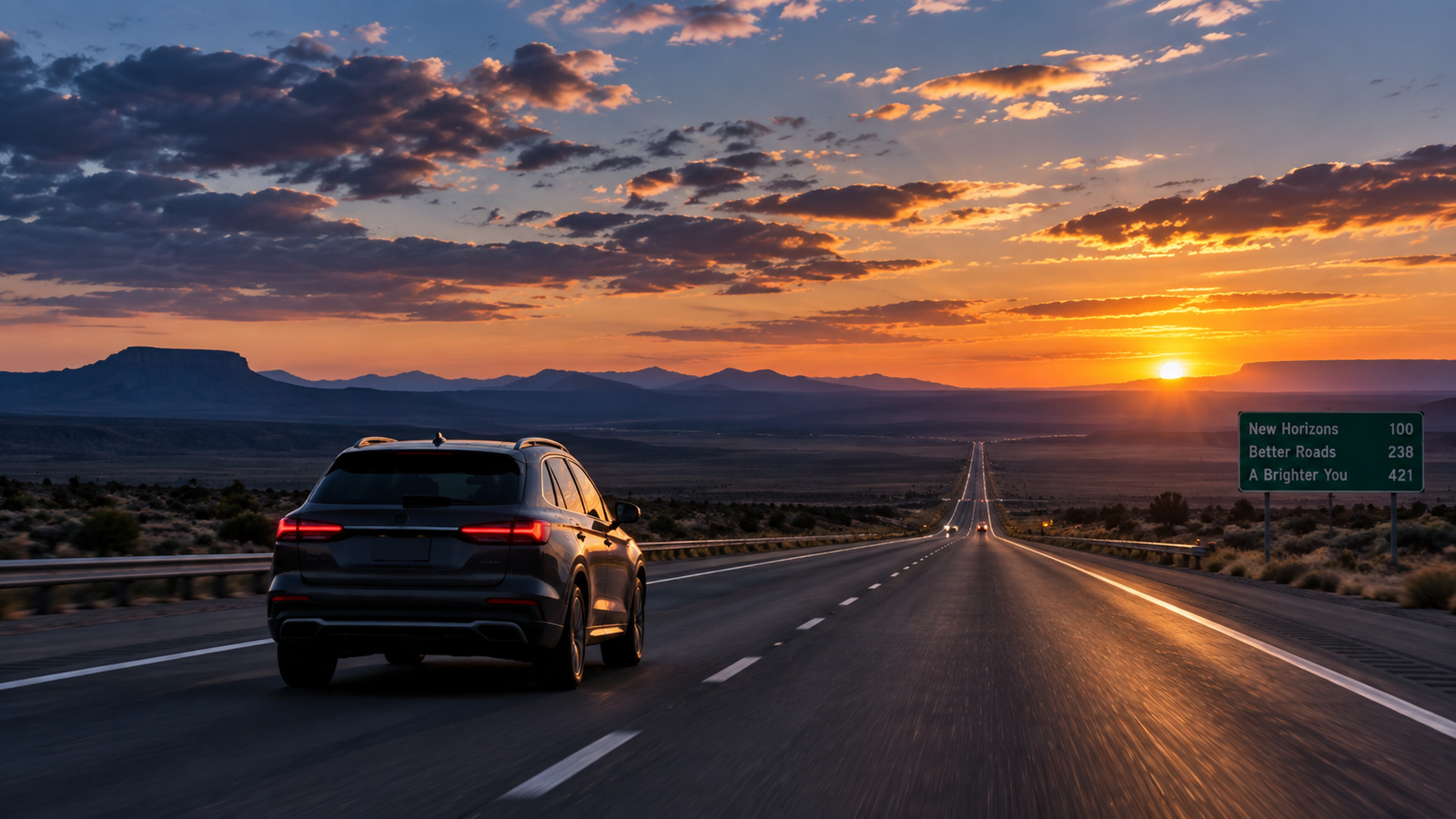
There is a particular feeling that appears when a highway stretches far beyond the horizon.
The road becomes wider.
The scenery begins to repeat.
The traffic settles into a rhythm.
And after a while, something changes.
You stop thinking about the individual miles and start thinking about the journey as a whole.
This is one of the strange things about highway driving.
It can be monotonous and relaxing at the same time.
It can feel effortless one moment and mentally demanding the next.
A long highway is not simply a piece of infrastructure connecting two places.
For the driver, it creates a completely different environment.
The speed is relatively constant. The road markings repeat. The scenery moves continuously through your peripheral vision.
And eventually, your relationship with the road begins to change.
The Rhythm of the Highway
Driving around a city requires constant decisions.
Traffic lights.
Intersections.
Pedestrians.
Parking.
Sudden lane changes.
Navigation decisions can arrive every few seconds.
A highway removes much of that complexity.
The road ahead becomes predictable.
Your hands settle into a natural position on the steering wheel.
Your speed becomes consistent.
The engine settles into a steady rhythm.
This repetition can create a surprisingly calming effect.
You still need to remain attentive, of course. Long highway driving requires continuous awareness of traffic, road conditions and fatigue.
But the mental environment is different.
Instead of constantly reacting to new situations, you spend more time anticipating what comes next.
That creates a rhythm.
And rhythm is one of the reasons long drives can become so immersive.
Why the Scenery Starts to Feel Different
At the beginning of a road trip, everything feels new.
The first town.
The first mountain.
The first unfamiliar exit.
The first stretch of road you have never driven before.
But several hours later, the scenery becomes less important as individual objects.
Instead, it becomes an atmosphere.
Mountains become silhouettes.
Fields become patterns.
Buildings become flashes of color.
Road signs become brief moments of information.
The landscape becomes part of the background rather than something you consciously examine every second.
This is when driving can begin to feel almost cinematic.
The windshield becomes a moving frame.
The road becomes the central line through the image.
And the landscape continuously changes around it.
It is one of the reasons a familiar road can still feel different when you drive it at another time of day.
Long Roads Change Your Sense of Time
A long drive can make time feel strangely flexible.
Twenty minutes can disappear without you noticing.
Then the final thirty miles before your destination can seem to take forever.
The reason is partly the repetitive nature of highway travel.
When there are fewer major events to remember, individual moments can blend together.
You may remember leaving a city.
You may remember stopping for coffee.
You may remember a beautiful sunset.
But hundreds of miles between those moments can become one continuous memory.
That is not necessarily a bad thing.
In fact, it may be part of what makes road trips memorable.
The journey becomes less about individual events and more about the feeling of movement.
The Car Becomes Part of the Environment
During a short drive, you may think about the car itself.
The engine.
The steering.
The suspension.
The interior.
During a long drive, those things become more subtle.
You learn how the car behaves.
You learn how much steering input it needs.
You begin to recognize the engine note at cruising speed.
You understand how it reacts when the road surface changes.
Eventually, the car becomes an extension of your routine.
This is one reason a comfortable and predictable car can be so satisfying on a long journey.
It does not constantly remind you that you are operating a machine.
It simply responds.
That relationship between driver and car is part of what makes a car feel special.
Why Music Feels Better on the Open Road
Music has always been closely connected to driving.
But a highway creates a particularly good environment for listening.
There are fewer interruptions.
The cabin becomes your private space.
The road provides a constant visual rhythm.
And the music provides another layer of movement.
A steady electronic beat can seem to synchronize with the lane markings passing beneath the car.
A slower ambient track can make an empty highway feel almost dreamlike.
A familiar song can suddenly become attached to a particular road, sunset or destination.
This is why a song can bring back a driving memory years later.
You may not remember exactly where you were.
But you remember the feeling.
The road.
The light.
The sound.
The car.
That relationship between sound and movement is at the heart of Progressive Trance and the Driving Experience.
The Highway Can Make You More Aware of the Car
There is another interesting contradiction.
A highway can make the car feel less important, while also making you more aware of it.
When the road is smooth and traffic is light, small characteristics become easier to notice.
You notice steering weight.
You notice suspension movement.
You notice how much wind reaches the cabin.
You notice whether the engine feels relaxed at cruising speed.
You notice how naturally the car maintains its direction.
These details might be invisible during a five-minute drive around town.
After three hours, they become part of the experience.
This is why long-distance driving can reveal things about a car that a short test drive cannot.
Why the Best Highway Cars Feel Calm
There is a reason calmness is such a valuable quality in a long-distance car.
Highway driving requires consistency.
You want the steering to feel predictable.
You want the suspension to absorb imperfections without creating unnecessary movement.
You want the cabin to remain relatively quiet.
You want the driving position to feel natural.
And you want the car to remain composed when conditions change.
These qualities may not create spectacular numbers on a specification sheet.
But they can make hundreds of miles feel considerably easier.
That is why the best cars for long drives are not necessarily the most powerful.
Long-distance driving rewards balance.
When the Road Becomes the Destination
Perhaps the most interesting thing about a long drive is what happens when you stop thinking exclusively about the destination.
At some point, the road itself becomes part of the reason you are driving.
You take the scenic route.
You slow down when the landscape opens up.
You stop at a viewpoint you did not plan to visit.
You take another ten minutes before turning toward the hotel.
The journey begins to have its own value.
This is the idea behind The Art of the Long Drive.
A long journey is not simply a distance that needs to be completed.
It is a collection of small moments that become meaningful because you were there to experience them.
The Psychology of an Empty Road
There is something powerful about seeing an open road ahead.
It creates possibility.
The destination may be known, but everything between here and there remains open.
You could take the next exit.
You could stop for coffee.
You could continue for another hundred miles.
You could discover a road you have never driven before.
This sense of possibility is one reason driving has become such an important part of automotive culture.
The car gives you mobility, but the road gives that mobility meaning.
It is not only about getting somewhere.
It is about being able to go.
Why Night Changes Everything
The highway feels different again when daylight disappears.
The landscape fades.
Buildings become points of light.
The road markings become more prominent.
Your headlights create a narrow visual tunnel ahead.
The cabin becomes darker and more isolated.
Traffic may decrease, and the atmosphere can become much more intimate.
This is one reason night drives feel different.
The same highway can feel completely different at midnight compared with midday.
The road has not changed.
But your perception of it has.
The Long Road Is Part of the Experience
Highway driving is sometimes criticized for being boring.
And sometimes it is.
There are long stretches where nothing particularly interesting happens.
But perhaps that is exactly why the experience can be so valuable.
Modern life rarely gives us many hours where the world narrows down to a road, a car and the space immediately around us.
The highway creates that space.
You watch the road.
You listen to music.
You think.
You observe the changing landscape.
You continue forward.
And somewhere along the way, the distinction between driving to a destination and simply enjoying the road can disappear.
That is when highway driving becomes more than transportation.
It becomes an experience.
And perhaps that is why some of our strongest automotive memories are not about speed at all.
They are about where we were going, who was beside us, what was playing through the speakers and how the road looked at that particular moment.
The miles eventually disappear.
The destination eventually arrives.
But the feeling of the drive can stay with you.
Cars. Roads. Music.
The Experience of Driving.