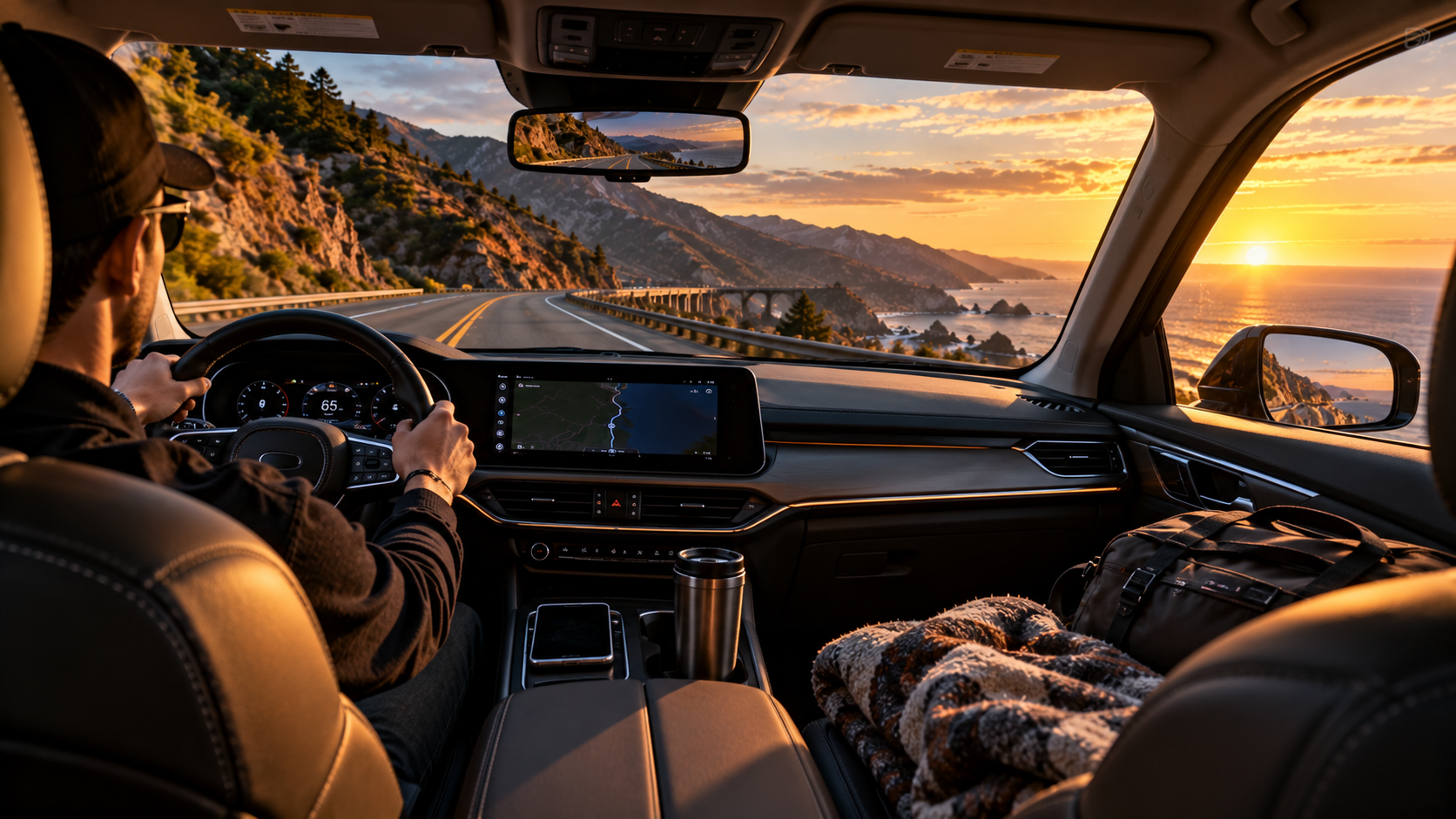
A long road trip can be one of the best ways to experience a car.
But after several hours behind the wheel, small details become much more important than they seemed at the beginning.
The seat that felt comfortable for thirty minutes may start feeling different. The cabin temperature may become annoying. The wrong shoes may become uncomfortable. A badly positioned bag may suddenly become a problem.
Comfort on a long drive is rarely about one expensive feature.
It is usually the result of many small decisions working together.
Comfort Changes When the Drive Gets Longer
Short drives allow you to ignore small inconveniences.
If the steering position is slightly wrong or the seat is not perfectly adjusted, you can usually tolerate it for twenty minutes.
A five-hour drive is different.
Small discomforts accumulate.
That is why preparing for a long road trip should involve more than checking the engine and filling the fuel tank.
The driver and passengers need to be comfortable too.
As we explored in Why Long Drives Are Good for Your Mind, part of the appeal of a long journey comes from settling into a rhythm. Comfort makes that rhythm easier to find.
1. Adjust the Driving Position Before Leaving
Start with the driver’s seat.
Your position should allow you to reach the pedals comfortably while maintaining a natural bend in your knees. Your hands should be able to control the steering wheel without forcing your shoulders forward.
Adjust the steering wheel, seat height, seatback and mirrors before the journey begins.
Do not wait until you are already on the highway.
A good driving position should feel natural rather than requiring constant correction.
2. Support Your Lower Back
Lower-back comfort becomes increasingly noticeable during long drives.
If your car has adjustable lumbar support, take a few minutes to find a position that feels natural.
If it does not, avoid immediately assuming that you need an elaborate aftermarket solution.
Sometimes a small adjustment to the seatback angle or seating position can make a meaningful difference.
The goal is to maintain a comfortable posture rather than creating pressure in one particular area.
3. Keep the Cabin Temperature Comfortable
A cabin that is too hot or too cold can make several hours of driving unnecessarily tiring.
Set the climate control to a comfortable temperature before leaving and adjust it gradually as conditions change.
Passengers may have different preferences, which is another reason clothing layers can be useful on long journeys.
A lightweight jacket or blanket can be easier than constantly changing the entire cabin temperature.
4. Keep the Windshield Clean
Visibility and comfort are closely connected.
A dirty windshield can create glare, especially when the sun is low or when headlights approach at night.
Clean the inside and outside of the windshield before a long trip. Make sure the washer fluid is filled and the wipers are working properly.
This becomes particularly important if the journey includes changing weather.
A clean windshield makes the road easier to read and reduces unnecessary visual effort.
5. Choose the Right Shoes
Footwear may seem like a minor detail, but drivers spend hours interacting with the pedals.
Comfortable shoes with suitable soles can make pedal control feel more natural.
Avoid footwear that is excessively loose, overly bulky or otherwise interferes with safe pedal operation.
The best choice is usually the simplest one: something comfortable that allows precise control.
6. Organize the Cabin Before You Leave
Nothing makes a road trip feel more chaotic than searching for things while the journey is already underway.
Keep frequently used items within easy reach when the vehicle is safely stopped.
Water, charging cables, sunglasses and small personal items should have designated places.
Passengers can also help by keeping their own belongings organized.
A clean cabin creates a calmer environment, particularly when the journey lasts all day.
7. Don’t Put Everything in the Driver’s Reach
There is a difference between making useful items accessible and creating distractions.
The driver should not be reaching for a phone, searching through bags or adjusting equipment while the vehicle is moving.
Navigation should be set before departure or adjusted only when safely stopped.
The same applies to music.
A good road-trip playlist is useful precisely because it reduces the need to interact with devices during the drive.
8. Take Regular Breaks
A long drive should not be treated as a test of how many hours you can remain behind the wheel without stopping.
Regular breaks give the driver an opportunity to stretch, drink water, use the restroom and reset their attention.
The ideal rhythm depends on the driver, passengers, road and journey.
There is no prize for reaching the destination without stopping.
Sometimes the best decision is simply to pull over for a few minutes and continue when everyone is ready.
9. Make Fuel Stops Part of the Journey
Fuel stops do not have to be interruptions.
They can become natural checkpoints in the journey.
Stretch your legs. Clean the windshield. Check the tires visually. Get some water. Then continue.
For EV drivers, charging stops can serve a similar purpose.
The stop becomes part of the rhythm rather than something that needs to be rushed.
10. Pack the Trunk Properly
How luggage is arranged can affect both convenience and the overall feeling of the journey.
Heavy items should be secured appropriately and lighter items can occupy the remaining space.
Keep things you may need during the trip accessible rather than placing them underneath everything else.
There is nothing particularly enjoyable about unloading half the trunk at a rest stop because a small bag was packed at the bottom.
For more ideas about what is actually worth carrying, see What to Pack for a Long Road Trip: The Essentials You’ll Actually Use.
11. Choose the Right Driving Pace
Speed is not the only factor that determines how quickly a journey feels.
Constant acceleration, braking and lane changes can make a long drive feel more demanding.
When traffic and road conditions allow, maintaining a smooth and predictable driving rhythm can make the journey feel considerably calmer.
This does not mean driving below the appropriate flow of traffic or ignoring road rules.
It means avoiding unnecessary aggression.
A long road trip is a different experience from a short sprint.
12. Use Cruise Control When Appropriate
On suitable highways, cruise control can reduce the amount of constant pedal input required from the driver.
Adaptive cruise control can go further by helping maintain a selected following distance, depending on the vehicle and system.
These systems are driver assistance tools, not replacements for attention.
The driver remains responsible for monitoring the road and responding to changing conditions.
Used appropriately, however, they can make long highway sections feel less demanding.
13. Build the Right Playlist
Music can change the perceived length of a journey.
A playlist with too much repetition can become tiring. A playlist with constant high energy can also become exhausting after several hours.
Consider building different sections for different parts of the journey.
Something energetic for departure. Something more atmospheric for the highway. Something calm for the final section.
Progressive trance can work particularly well because the music can evolve gradually rather than constantly demanding attention.
The relationship between music and movement is one of the things that makes driving unique.
AutoWalkthrough explores that relationship in Progressive Trance and the Driving Experience.
14. Let the Scenery Change the Rhythm
One of the easiest mistakes on a road trip is becoming obsessed with arrival time.
Of course, schedules matter.
But if the journey allows some flexibility, give yourself permission to notice the environment.
A mountain appears in the distance. The road begins following a river. The landscape changes from forest to open farmland.
These moments are part of the reason for taking the road in the first place.
As Why Some Roads Are More Enjoyable Than Others explores, scenery and road design can have a major influence on how a journey feels.
15. Don’t Ignore Fatigue
Comfort should never be confused with the ability to drive indefinitely.
A comfortable seat does not eliminate fatigue.
Modern cars can make long-distance driving easier, but the driver still needs adequate rest and attention.
If you become sleepy, stop driving.
Take a proper break, change drivers if another qualified and alert driver is available, or find a safe place to rest.
Arriving later is better than continuing when you are no longer alert enough to drive safely.
16. Give Passengers Their Own Space
A comfortable driver is important, but passengers can also influence the atmosphere inside the vehicle.
Give each passenger reasonable space for personal items and make sure commonly used things are easy to access when safely stopped.
For families, entertainment and snacks can be prepared before departure.
For couples or friends, simply agreeing on music, temperature and break preferences can prevent small disagreements from becoming road-trip problems.
17. Don’t Make Every Kilometer About Efficiency
There is a tendency to optimize everything during modern travel.
Shortest route. Lowest fuel consumption. Fastest arrival. Fewest stops.
Efficiency is useful, but it should not completely define the journey.
Sometimes a slightly longer route can be more enjoyable.
A scenic road, a quiet town or a worthwhile viewpoint can become the part of the journey you remember.
The best road trip is not necessarily the one that produces the best statistics.
Comfort Is About the Whole Experience
A comfortable road trip is not created by one feature.
It comes from the combination of a suitable car, a good driving position, an organized cabin, reasonable breaks, appropriate speed, good music and enough time to enjoy the road.
This is why the idea of the perfect road-trip car is difficult to define.
The vehicle needs to match the journey.
As The Best Cars for Long Drives Aren’t Always the Fastest explains, characteristics such as comfort, stability, practicality and range can become more important than outright performance.
The Road Should Feel Like Part of the Experience
There is a difference between surviving a long drive and actually enjoying one.
Survival is measured by arrival.
Enjoyment is measured by everything that happens along the way.
The first stretch of highway after sunrise. The perfect song appearing at the right moment. A mountain road appearing around a corner. A quiet stop for coffee. The changing light across the dashboard.
These are the details that turn distance into experience.
Make the Journey Easier, Not More Complicated
You do not need a heavily modified car or a trunk full of expensive equipment to make a road trip comfortable.
Start with the basics.
Set the seat correctly. Keep the cabin organized. Prepare your route. Bring water. Take breaks. Choose good music. Give yourself enough time.
Then let the car do what it was designed to do.
Move.
Because once the small details are taken care of, the road becomes the interesting part again.
And that is where a long drive becomes more than transportation.
It becomes an experience.